

Hyperion Strings Micro is Soundiron's entry-level Hyperion string library for Kontakt Player. It takes the core idea of the larger Hyperion series, keeps the footprint light, and gives producers an immediate orchestral string palette with enough controls to shape the room, width, dynamics, and section balance.
What Hyperion Strings Micro Is
Soundiron built Hyperion Strings Micro as the lightest version of the Hyperion Strings line. The library runs in Native Instruments' free Kontakt Player as well as the full version of Kontakt, and it also supports Komplete Kontrol, S-Series keyboards, and NKS workflows.
The library includes a full ensemble patch and four section patches: 8 violins, 6 violas, 5 cellos, and 4 double basses. Instead of trying to cover every orchestral articulation, Micro focuses on the essentials: dynamic sustains, vibrato and non-vibrato options, staccatos, spiccatos, pizzicatos, crescendos, and decrescendos.
The Sound
Hyperion Strings Micro has a close, dry, forward tone. That is the point of the library. Soundiron recorded the ensemble sections at Studio A at Fantasy Studios in Berkeley, California, then gave the interface enough spatial tools to push the strings closer, farther back, wider, narrower, drier, or more cinematic.
Out of the box, the sound is immediate and present. That works well when you want strings to cut through drums, synths, guitars, or trailer-style percussion. It can also feel a little aggressive if you expect a soft, distant concert-hall string section right away. The best results come from treating Micro as a flexible close-mic source: shape the attack, body, dynamics, reverb, and space controls until the strings sit in your track.
Articulations and Playability
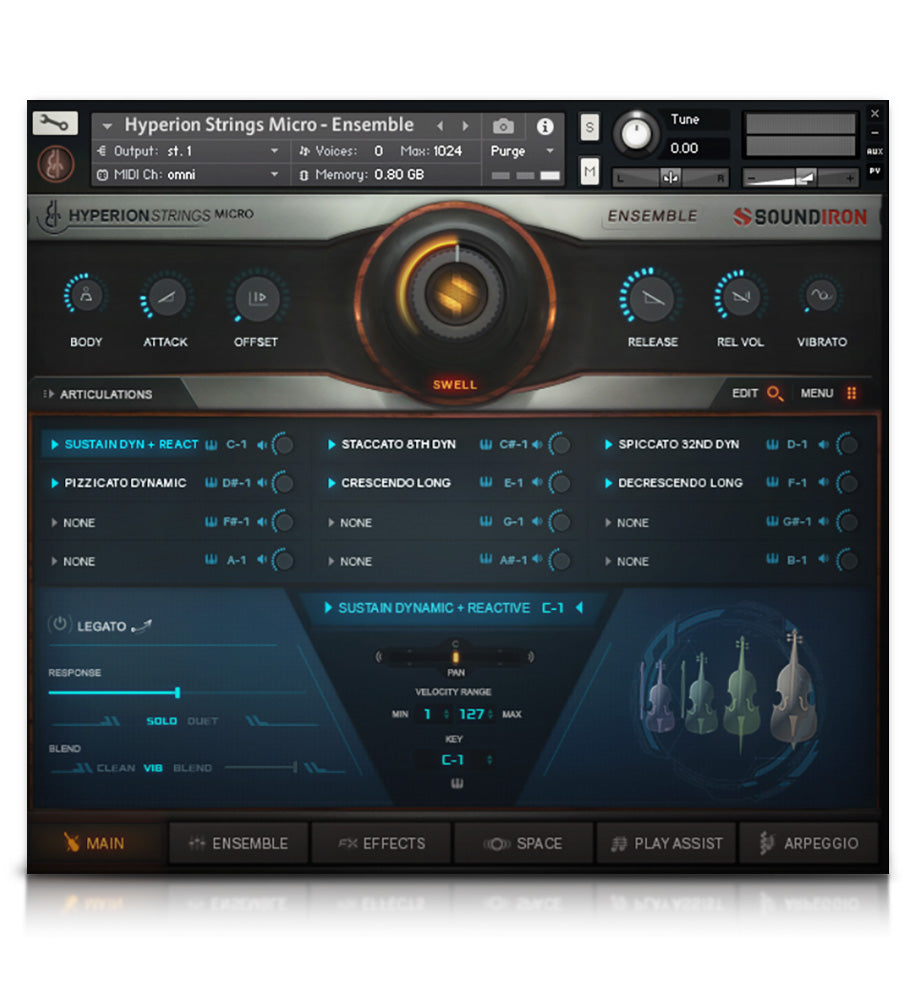
The main articulations cover the parts most producers reach for first. Sustains can move through dynamic layers with the Swell control, and the sustain tone can blend between natural vibrato and non-vibrato. Short articulations include staccato, spiccato, and pizzicato, with velocity-sensitive behavior available when you want dynamics to follow how hard you play.
The library also includes long crescendos and decrescendos, which are useful for transitions, film-style builds, breakdowns, and EDM rises. The short articulations use two round-robin variations per note. That helps avoid machine-gun repetition, though it is still a compact library, so repeated exposed ostinatos may need programming care.
The Interface
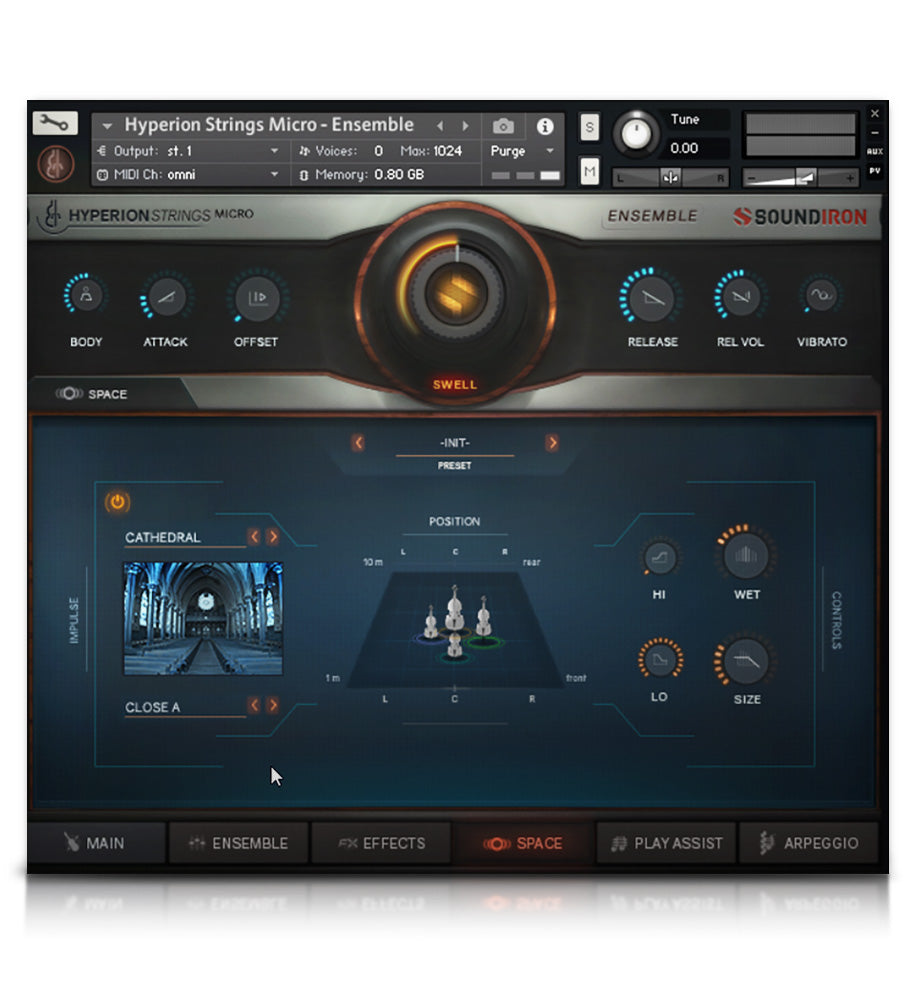
Hyperion Strings Micro is more configurable than its size suggests. The main panel handles articulation slots, volume, pan, ranges, dynamics, attack, body, release, sample offset, and vibrato behavior. The Space panel is especially important because it turns the close recording into something more mix-ready.
You can place the sections inside a virtual stage, add convolution reverb, and decide how close or distant the ensemble feels. This is where Micro starts to make sense: Soundiron did not ship a large multi-mic orchestral library here. It shipped a small dry source with controls that let you build the space yourself.
Strengths
Best for
Producers who want a compact orchestral string library that can sit in pop, EDM, cinematic, game, and hybrid arrangements without a huge install.
Main strength
The dry close recording and deep spatial controls make the library more flexible than its small footprint suggests.
Main limitation
Micro keeps the essential articulations, but it is not as detailed as larger string libraries with more mic positions, legato depth, and round robins.
The biggest strength is value. Hyperion Strings Micro keeps the install size low, works in Kontakt Player, includes the section patches you need for quick arrangements, and gives enough sound-shaping control to move from tight modern strings to wider cinematic textures. For electronic producers, that matters more than a huge list of advanced scoring features.
Limitations
The tradeoff is detail. Micro has one close source perspective, fewer articulations than the larger Hyperion editions, limited round robins, and a sound that needs some shaping before it feels lush. If your main goal is highly exposed orchestral realism, Micro is better as a sketching or layering tool than the final word.
It also does not replace a complete string ensemble library. Producers who need more mic positions, deeper legato, more bowing options, more dynamic variation, or larger orchestral templates should look at Soundiron's larger Hyperion editions or other full string libraries.
Who Should Use It
Hyperion Strings Micro makes the most sense for songwriters, electronic producers, media composers, and beginners who want an affordable Kontakt Player string library that loads quickly and does not demand a full orchestral workflow. It is also useful for experienced producers who already own larger libraries but want a dry, direct layer that can add bite, width, or motion.
If you write pop, EDM, cinematic electronic, hip-hop, trailer cues, game music, ambient, or hybrid orchestral music, Micro gives you a fast way to add real string color without leaving the production mindset.
Final Verdict
Hyperion Strings Micro is not trying to be a massive flagship string library. Its job is to give you a focused, playable, affordable string toolkit with enough control to work in modern productions. On that brief, it succeeds.
The close sound may need EQ, reverb, and careful attack/dynamics shaping, but the library rewards that work. For producers who want real string sections inside Kontakt Player without a huge install or steep learning curve, Hyperion Strings Micro remains a practical choice.
Sources and Further Reading
- Soundiron Hyperion Strings Micro product page
- Sample Library Review: Hyperion Strings Micro by Soundiron
- KK-Access: SoundIron Hyperion Strings Micro full review
More SoundShockAudio Resources
Browse more string libraries and orchestral instruments.
Kontakt InstrumentsFind Kontakt libraries for scoring, sound design, and production.
Free DownloadsExplore SoundShockAudio plugins, sample packs, presets, MIDI, and templates.
Related guides
- Strings VST Plugins - browse more string instruments and orchestral plugins
- Kontakt Instruments - find Kontakt libraries for scoring and production
- Free Downloads - browse the full SoundShockAudio library