
Azimuth
Key Features
- Combines virtual analog oscillators and wavetable mode in a six-voice synth engine.
- Uses a four-source X/Y pad to blend oscillator levels and record expressive, repeatable movement.
- Lets note and velocity data modulate the X/Y position for keyboard-responsive timbral changes.
- Provides a selectable source filter plus a separate global multimode filter for layered tone shaping.
- Includes dedicated gain, filter, and pitch LFOs for animated pads, arpeggios, and evolving leads.
- Finishes patches with phaser, three-point EQ, convolution reverb, and delay in the master-effects section.
Description
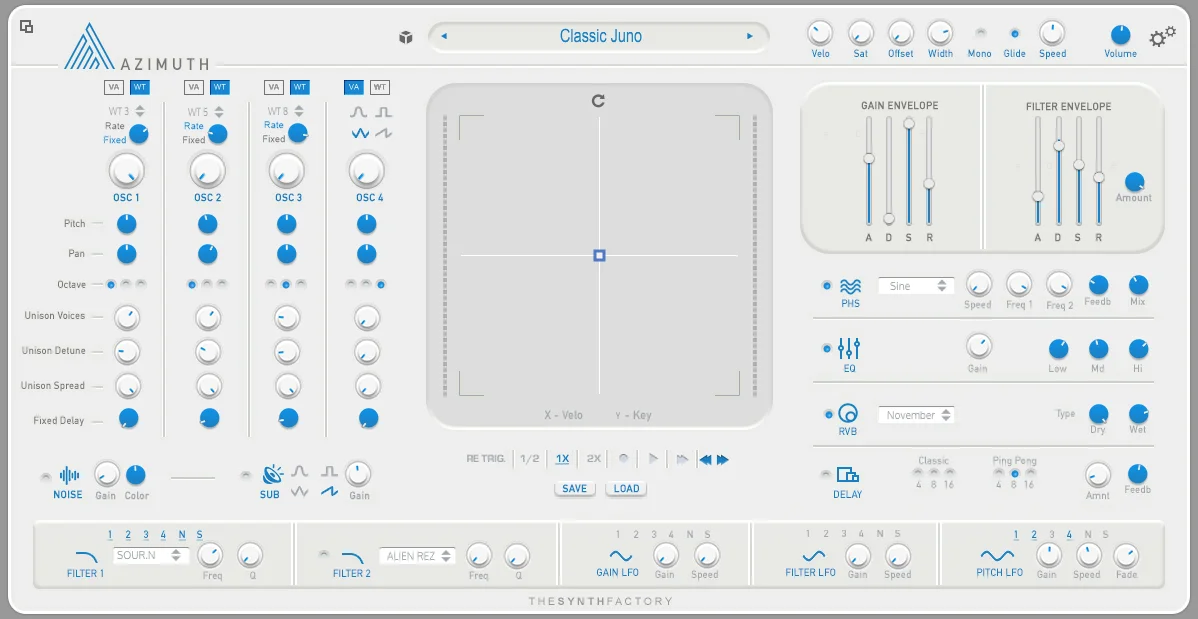
Azimuth is a six-voice virtual analog and wavetable synthesizer from TheSynthFactory, built around four oscillators, multimode filtering, and a large X/Y performance pad. Each oscillator can run a standard waveform or a wavetable, allowing clean subtractive tones and more animated digital timbres to share the same compact interface.
The X/Y pad blends the four oscillator levels and can record its movements for tempo-based playback. Key and velocity can also modulate its position, making it a practical way to turn a held chord, pad, or arpeggio into a changing layered sound without complicated routing.
Two filters divide the sound-shaping work: the first can be assigned to a selected source, while the second acts globally. Gain, filter, and pitch LFOs add motion, then phaser, three-point EQ, convolution reverb, and delay provide a concise master-effects section for finishing patches in the instrument.
Azimuth is available for Windows and macOS in 64-bit VST3, with AU also supplied on Mac. The developer page currently lists it at £0.00 and presents its own cart flow.
Frequently Asked Questions
What kind of synthesis does Azimuth use?
Azimuth combines virtual analog and wavetable operation. Its four main oscillators can use saw, triangle, square, or sine shapes, or switch to the wavetable category for a different harmonic character.
What does the X/Y pad control?
The X/Y pad is assigned to the volume of the four main oscillator-based voices, so moving it crossfades between layers. The developer says you can record a movement pattern, set its retrigger, speed, and direction, or modulate its position from note and velocity data.
Does Azimuth include effects?
Yes. Its fixed master section includes phaser, three-point EQ, convolution reverb, and delay. The delay offers classic and ping-pong modes, while the synth page also describes multimode filters and three LFO areas for additional movement.
Which plug-in formats are available?
The developer lists 64-bit VST3 for Windows and 64-bit AU plus VST3 for Mac. The same page lists Windows 7, 8, or 10 and later, and Mac OS X 10.9.5 Mavericks or later, including macOS Catalina, Big Sur, and M1-native support.


