
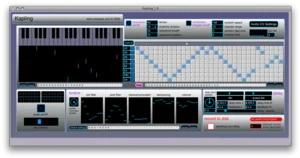
Kapling
Key Features
- Uses Karplus-Strong physical modeling for resonant plucked and melodic-percussion-style tones.
- Runs eight independent synth voices from an integrated 32-step sequencer.
- Provides realtime timbral controls for reshaping the character of each pattern as it plays.
- Randomizes the initial impulse to introduce natural variation across repeating sequences.
- Adds tempo-synced stereo delay and individual hotkeyed voice mutes for performance-oriented pattern control.
- Stores and exports pitch, sequence, and timbre presets, and can record output to disk as AIFF.
Description
Kapling is a standalone Mac physical-modeling synthesizer that uses the Karplus-Strong algorithm to create resonant, plucked-string and melodic-percussion timbres. Rather than operating as a DAW plug-in, it pairs eight independent synth voices with a built-in 32-step sequencer for making rhythmic, twangy, boingy, and clonk-like patterns.
Each voice can be shaped with realtime timbral controls, while randomized initial impulses introduce natural variation as a sequence repeats. The app also gives each voice a hotkeyed mute switch, making it practical to bring parts in and out during an improvised performance.
Kapling includes a tempo-synced stereo delay for adding spatial repeats to its physically modeled tones. Pitch, sequence, and timbre presets can be stored and exported, so a useful pattern can be returned to instead of rebuilt from scratch.
For committing an idea, Kapling can record its output directly to disk as an AIFF file and includes a CPU monitor for keeping an eye on processing load. It is best approached as a compact standalone pattern-and-sound generator for producers and live experimenters who enjoy percussive resonance and algorithmic variation.
Frequently Asked Questions
Is Kapling a DAW plug-in?
No. The official sineqube page describes Kapling as a standalone physical-modeling synthesizer application for Mac OS X built with Max/MSP. It is designed around its own eight-voice sequencer rather than a VST, AU, or other DAW plug-in format.
What kind of sounds does Kapling make?
Kapling uses the Karplus-Strong algorithm to emulate resonant bodies, such as a plucked string or struck melodic percussion instrument. The developer characterizes its results as twangy, boingy, and klonky.
How does Kapling create patterns?
Eight independent synth voices are triggered by a 32-step sequencer. Realtime timbral controls and randomized initial impulses let a repeating pattern change in character over time.
Can Kapling save or record a performance?
Yes. The official feature list says it can store and export presets for pitch, sequences, and timbre, and record its output directly to disk as an AIFF file.


