
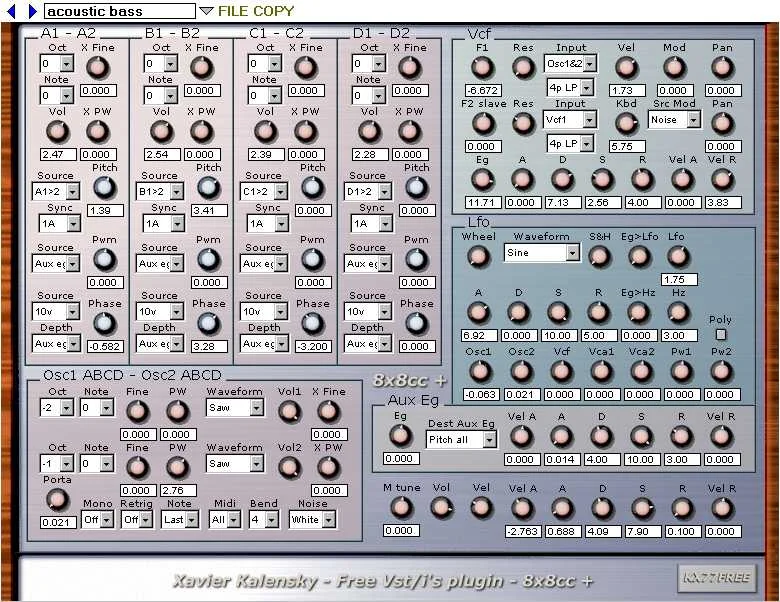
8X8CC plus
Key Features
- Eight oscillators per voice create a large starting point for layered virtual-analog sounds.
- Paired oscillators can be detuned and sent to a stereo output for wider ensemble textures.
- A modulation matrix supports more involved routing than a basic subtractive synth layout.
- An additional envelope generator expands control over evolving timbres and note shapes.
- The LFO can run in monophonic or polyphonic modes for shared or per-voice modulation movement.
- The sound design focus spans ensemble-style strings, brass, choirs, guitar-like tones, basses, pads, and unison leads.
- The official developer page still provides separate P8, P6, and P4 downloads for different CPU targets.
Description
8X8CC plus is a legacy Windows virtual-analog synth by Xavier Kalensky built around eight oscillators per voice and a modulation matrix. Its paired oscillators can be detuned into a stereo output, making it suited to layered ensemble-style patches rather than a minimal subtractive-synth workflow.
The design targets string, brass, choir, guitar-like, and bass-like tones, while also covering synthetic pads and unison leads. An extra envelope generator and an LFO that can operate monophonically or polyphonically add movement to its large voice architecture.
This is a deliberately hands-on, deep instrument: its dense single-window layout rewards users who want to explore routing and oscillator relationships. Community feedback describes the routing options as unusually broad, but also notes that the interface and programming depth can take time to learn.
Kalensky provides P8, P6, and P4 builds from the current KX77FREE site; this entry links to the P8 build. The product is a 32-bit Windows VST from the mid-2000s, so it is best treated as a legacy option for a compatible VST host rather than a current VST3, AU, or macOS instrument.
Frequently Asked Questions
What does the “plus” version add to 8X8CC?
The developer describes 8X8CC plus as the eight-oscillator-per-voice version with a modulation matrix. It also adds an envelope generator and lets the LFO run monophonically or polyphonically.
What kinds of sounds can 8X8CC plus make?
Its developer highlights classical-ensemble-style strings, brass, choirs, guitar-like sounds, and basses. The same oscillator-and-detune design can also be used for synthetic pads and unison leads.
Why are there P8, P6, and P4 downloads?
The official download table provides three builds identified as P8, P6, and P4. The source does not define those labels further, so choose the build intended for your compatible older Windows system and VST host.
Is 8X8CC plus suitable for current Mac or VST3-only setups?
No current macOS, VST3, AU, AAX, or CLAP build is listed by the developer. The available release is a legacy 32-bit Windows VST, so compatibility depends on an older host that can load that format.


