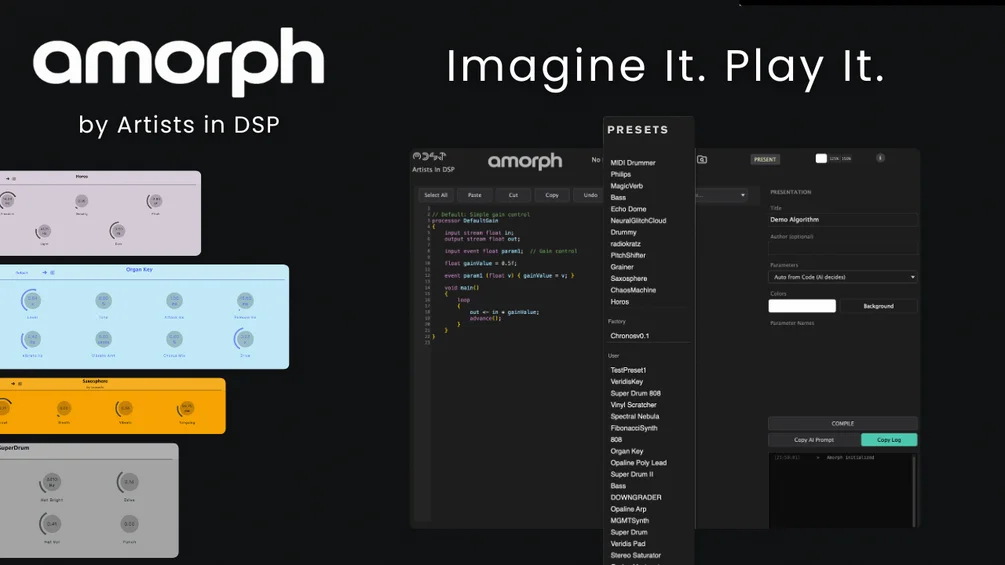
Amorph
Key Features
- Current installer bundles three focused variants, so you can compile custom instruments, audio effects, or MIDI tools without forcing every idea through the same plugin shell
- Ask, Compile, and Play workflow turns plain-language requests into Cmajor code that can be pasted back into the plugin and rendered directly inside a DAW session
- Custom UI engine lets advanced users prompt HTML and JavaScript interfaces, opening the door to boutique controls, visualizers, and more purpose-built front panels
- The Hub adds an in-plugin browser for community patches, making it easier to preview, install, remix, and share unusual devices instead of starting every experiment from zero
- Performance improvements in the current beta focus on sample-accurate MIDI timing and more reliable parameter recall, which addresses some of the fragility common to early generative tools
- Safety Mute, local DSP execution, and editable Cmajor access keep the product useful for both curious non-coders and experienced users who want to inspect or refine what the AI generated
Description
Amorph is a prompt-driven plugin environment from Artists in DSP that turns text-led ideas into working instruments, effects, and MIDI tools inside one open-beta package. Instead of loading a fixed synth or processor, you generate or edit Cmajor code from a plain-language brief, paste it into Amorph, and compile a custom device directly in your DAW.
That makes Amorph most compelling as a fast sketchpad for experimental sound design rather than a replacement for polished mix staples. Official examples span granular reverbs, tape-style distortion, bespoke synths, Euclidean arpeggiators, and reactive visualizers, while recent coverage notes that the plugin now ships as separate Instrument, Effect, and MIDI variants so the workflow is more focused than the original two-plugin beta.
The current v0.99 beta also pushes beyond raw DSP generation by adding a custom UI engine and The Hub, a cloud browser for community patches. Those additions turn Amorph from a one-off code compiler into a broader sandbox for sharing, remixing, and refining unusual devices without building a full plugin project from scratch.
The tradeoff is predictability, because Artists in DSP still labels the release as open beta, warns that AI-generated DSP can behave unpredictably, and recommends keeping a limiter on the master bus while testing new patches. Even so, the official Gumroad listing still prices the product at $0+, and the April update cycle suggests this is an actively maintained freeware platform rather than a short-lived launch giveaway.
Frequently Asked Questions
Is Amorph one plugin or multiple plugins?
The current official package includes three variants: Amorph Instrument, Amorph Effect, and Amorph MIDI. That split makes it easier to build sound generators, audio processors, or MIDI utilities without overloading a single interface.
Do I need to know DSP coding to use Amorph?
Not necessarily. Artists in DSP positions Amorph around a prompt-first workflow where you generate a request, ask an LLM for Cmajor code, and paste the result back into the plugin, but the code stays accessible if you do want to edit it manually.
Does Amorph work fully offline?
The DSP engine itself runs locally, so compiling and using generated devices does not require a constant cloud connection. The exception is The Hub, which needs internet access when you want to browse and install community patches from inside the plugin.
Does the current version still support CLAP?
The launch coverage mentioned VST3, AU, and CLAP, but the live v0.99 Gumroad page now lists only VST3 and AU. The current official formats are VST3 and AU unless the developer adds CLAP back to the product page.
Is Amorph stable enough for critical mixing or mastering work?
It is still explicitly labeled as open beta, and the developer warns that AI-generated DSP can be unpredictable. It makes more sense as a creative sandbox for unusual instruments, effects, and MIDI ideas than as a guaranteed replacement for trusted surgical processors.