
Bark of Dog
Key Features
- Three processing modes (Classic, Passive, Combo) for different approaches to low-frequency enhancement
- Stereo, mid-only, and side-only processing for independent bass image control
- Pultec-style simultaneous boost and cut that adds weight without introducing muddiness
- Analog mode applies subtle harmonic distortion to shape filter character at high boost levels
- Continuously variable center frequency knob with dry/wet blend for parallel processing
- A/B comparison for quick before-and-after evaluation of low-end changes
- Lightweight single-purpose design with an intuitive three-knob interface
Description
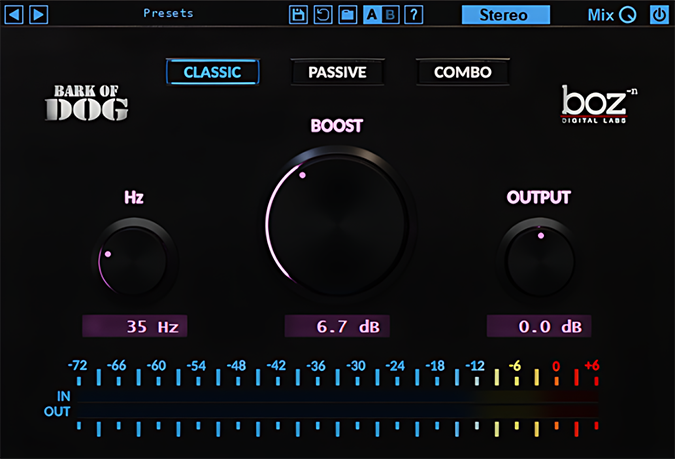
Bark of Dog 3 by Boz Digital Labs is a low-frequency enhancer built around a resonant high-pass filter and Pultec-style boost-attenuation EQ. It tightens the low end of a mix while simultaneously adding weight at a chosen center frequency, solving the common problem of bass that sounds either muddy or thin.
The plugin offers three processing modes. Classic mode uses a resonant high-pass filter that cleans up low-end rumble while boosting the target frequency, Passive mode borrows the Pultec technique of simultaneous boost and cut for aggressive enhancement without mud, and Combo mode blends both approaches with an integrated high-pass filter.
Processing works in stereo, mid-only, or side-only configurations, making it useful for widening or tightening the bass image independently. The new Analog mode in version 3 adds subtle harmonic distortion that changes the filter character, particularly effective at higher boost settings where it helps tame extreme peaks.
The interface keeps things deliberately simple with three main controls: Frequency, Boost, and Gain, plus a dry/wet blend for parallel processing. Users on Reddit and audio forums frequently compare it to the Waves Voice of God (LoAir), noting that while a resonant high-pass filter can be replicated in any parametric EQ, Bark of Dog's dedicated workflow makes the process faster and more intuitive.
Bark of Dog 3 supports 64-bit AU, VST2.4, VST3, and AAX formats on macOS 10.13 or later and Windows 7 or later.
Video Preview


Frequently Asked Questions
What does Bark of Dog actually do to the signal?
Bark of Dog applies a resonant high-pass filter that rolls off sub-bass frequencies below a chosen center point while simultaneously boosting energy at that frequency. The result is a tighter, more focused low end with added weight at the exact frequency you want to emphasize.
How is Bark of Dog different from using a resonant high-pass filter in a parametric EQ?
Technically, the core effect can be achieved with any parametric EQ's resonant high-pass filter. Bark of Dog's advantage is workflow: the dedicated interface with three modes (Classic, Passive, Combo) and the Analog saturation mode makes the process faster than dialing in the same settings manually. Developer Boz Millar has acknowledged this, noting that the plugin packages a useful technique into a more accessible format.
Should I use Bark of Dog on individual tracks or the master bus?
Both approaches work well depending on your goal. Many users apply it to individual bass and kick tracks for surgical low-end shaping, while others use it on the master bus to warm up the overall low end. If you use it on a bus with full-range material, the Mid/Side processing modes help avoid unwanted changes to the stereo image of higher frequencies.
What is the difference between the three processing modes?
Classic mode is a resonant high-pass filter for low-end cleanup with a targeted boost. Passive mode uses Pultec-style simultaneous boost and attenuation for more aggressive enhancement without mud. Combo mode combines both into a single processing chain with an integrated high-pass filter, offering the most flexibility.


