
Baxter EQ
Key Features
- Baxandall shelving filters with 8 low-frequency and 9 high-frequency stepped positions for precise tonal sweetening on the master bus
- 2-pole Butterworth high-pass and low-pass filters for removing rumble and harsh high-end without affecting the shelving character
- Full mid/side encoding support for independent processing of center and side content during mastering
- Stepped controls throughout every parameter for exact recall between sessions and matched dual-channel operation
- Per-channel output level controls for instant A/B comparison of EQ adjustments at matched loudness
- Analog signal path emulation that adds subtle stereo imaging improvements beyond the EQ processing
- 64-bit floating point internal processing with oversampling for artifact-free, transparent sound quality
Description
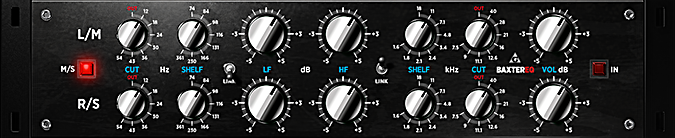
BaxterEQ by Variety Of Sound is a transparent mastering and mix bus shelving EQ inspired by Peter Baxandall's legendary tone control circuit. It provides Baxandall shelving filters and Butterworth high-pass/low-pass filters in a dual-channel layout with mid/side encoding, designed to add tonal polish at the final stage of a mix.
The shelving filters offer meticulously selected frequency steps across the low and high bands, with the low shelf ranging from 74 Hz to 361 Hz and the high shelf from 1.6 kHz to 18 kHz. Two 2-pole Butterworth filters handle the cut duties, with the low cut spanning 12 Hz to 54 Hz and the high cut from 7.5 kHz to 40 kHz.
Stepped controls on every parameter ensure repeatability between sessions and matched operation across the dual channels. The per-channel level controls let you A/B the effect of each shelving adjustment instantly, which is particularly useful when dialing in subtle tonal shifts on a mastering chain.
An analog signal path emulation adds subtle stereo imaging enhancements beyond the EQ processing itself. Combined with 64-bit floating point internal processing and oversampling for a clean impulse response, the plugin achieves a smooth, musical character that users praise for making mixes sound more finished and polished.
BaxterEQ runs as a VST and VST3 plugin on Windows in both 32-bit and 64-bit versions. The recommended workflow is to start in stereo L/R mode with linked controls for broad adjustments, then switch to mid/side mode to refine each channel independently.
Video Preview

Frequently Asked Questions
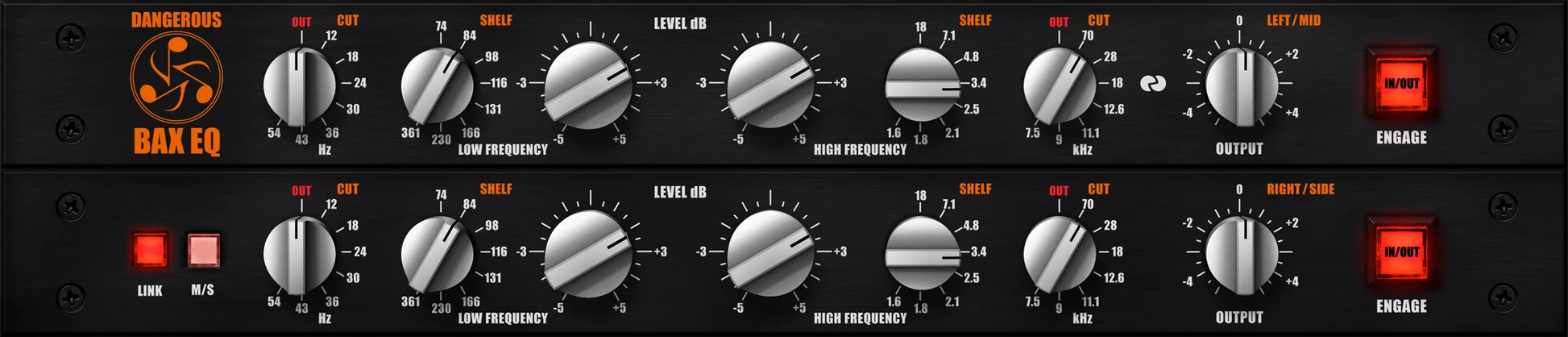
Is BaxterEQ based on the Dangerous BAX EQ hardware?
BaxterEQ draws inspiration from Peter Baxandall's tone control circuit, the same design philosophy behind the Dangerous BAX EQ hardware. It is not a direct copy or emulation of the Dangerous unit, but rather its own implementation of Baxandall shelving curves with additional features like mid/side processing and analog signal path emulation.
What is the recommended workflow for using BaxterEQ in mastering?
Start in stereo L/R mode with both channel controls linked to apply broad shelving and cutting adjustments. Then unlink the controls and switch to mid/side mode to refine the EQ per channel, adjusting the output volume control on each channel to fine-tune the stereo image.
Can BaxterEQ be used for surgical mixing tasks?
BaxterEQ is designed for broad tonal shaping, not surgical corrections. Its Baxandall shelving curves have a wide bandwidth and gentle slope that affect large frequency ranges, which makes it ideal for mastering and mix bus duties. For precise notch filtering or narrow-band corrections, a parametric EQ would be more appropriate.
Does BaxterEQ support 64-bit DAW hosts?
Yes. Version 1.2 added native 64-bit support in both VST and VST3 formats on Windows. The original release only supported 32-bit VST, but the current version runs natively in modern 64-bit DAW environments.


