
Chow Matrix

Key Features
- Build branching networks of delay nodes for multitap patterns and spacious effects.
- Adjust feedback, panning and gain independently for each node.
- Shape repeats with per-node high-pass and low-pass filters, distortion, pitch shifting and diffusion.
- Set delay times freely or synchronize them to the host tempo.
- Introduce random motion across nodes with the Insanity control.
- Use reverse and Alien delay options and expose node parameters to the DAW.
Description
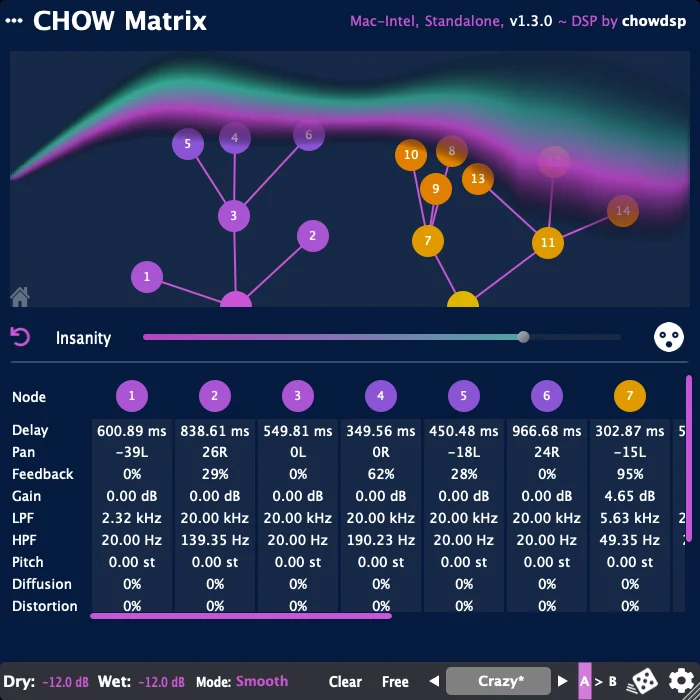
Chow Matrix by Chowdhury DSP is a creative delay plugin built around a branching tree of delay lines. Each node processes the signal from its parent, letting producers build anything from distinct rhythmic echoes to diffuse, reverberant textures.
Instead of working with a fixed set of taps, you can grow the tree and shape individual nodes. Controls for delay time, feedback, pan, gain, filtering, pitch, diffusion and distortion make it possible to give different repeats their own character.
Delay times can run freely or follow the host tempo. The Insanity control introduces random movement to the nodes, offering a way to add evolving variations to a delay pattern without manually adjusting every parameter.
The visual tree provides a picture of how the nodes connect, while the parameter grid makes their settings accessible for editing. Start with a small number of nodes to build a clear multitap rhythm, then add branches and diffusion when a broader wash is needed.
The developer publishes the source code under the BSD 3-Clause license and provides desktop releases for Windows, macOS and Linux. The latest desktop release also adds reverse delay, an Alien delay mode and controls for exposing node parameters to a DAW.
Frequently Asked Questions
How does the delay tree work?
Each node receives audio from its parent, sends a signal to its child nodes and contributes to the stereo output. Adding branches lets you create more complex paths of repeats.
Can delay times follow the song tempo?
Yes. Chow Matrix supports both free-running and tempo-synchronized delay times, so repeats can be set against the host tempo.
What does the Insanity control do?
It introduces random wandering to delay node parameters. This can add movement to a static network of repeats.
Can Chow Matrix create reverb-like effects?
Yes. Its branching delay lines and per-node diffusion can be used to build dense, spacious tails as well as distinct echoes.


