
DigiReactor

Key Features
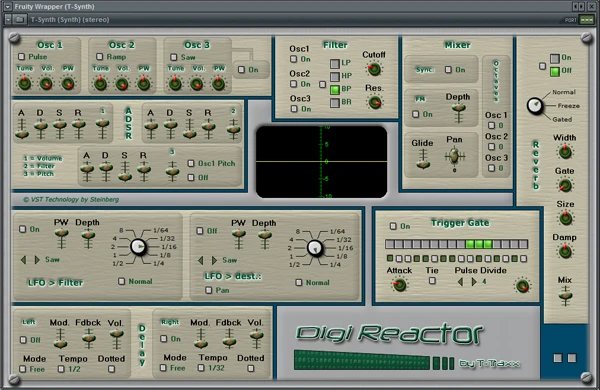
- Build sounds with three oscillators offering five waveform choices and individual octave settings
- Use FM mode to explore metallic sound effects
- Shape tones with low-pass, band-pass, high-pass and band-reject filter modes
- Modulate sounds with two LFOs and five waveform choices
- Adjust volume, filter and pitch with three dedicated envelopes
- Create rhythmic effects using the trigger gate
- Add reverb, two-channel delay, portamento and stereo panning
Description
DigiReactor is a Windows VST instrument by Jasper Vermorgen that combines three oscillators with an FM mode, a multimode filter and built-in effects. Released in 2008 and made with SynthEdit, it is a 32-bit plugin for musicians working with compatible hosts.
Each oscillator offers a choice of sine, saw, ramp, pulse and noise waveforms, with individual octave settings. The FM mode adds a route to metallic effects, while the trigger gate provides a way to create rhythmic sounds.
Two LFOs supply filter and custom modulation, with sine, saw, ramp, pulse and sample-and-hold shapes. Three envelopes shape volume, filter and pitch, and the filter offers low-pass, band-pass, high-pass and band-reject modes.
Reverb and a two-channel delay are built in, alongside portamento and stereo panning. Together these controls let you shape a sound inside the instrument before adding further processing in your host.
The developer provides a free download and lists Windows 98 or higher, at least a 500 MHz processor and 500 MB RAM recommended. DigiReactor is a legacy 32-bit VST 2 plugin, so check whether your host supports that format before planning to use it; the developer does not list Mac or Linux support.
Frequently Asked Questions
Does DigiReactor work in a 64-bit DAW?
DigiReactor is a 32-bit VST 2 instrument. Check your host’s support for 32-bit plugins or bridging before installing it.
Can DigiReactor run on macOS or Linux?
The developer lists Windows as the supported system and says the plugin does not work on Mac or Linux because of SynthEdit restrictions. A compatible Windows VST host is required.
What sounds can the FM mode create?
The developer describes the FM mode as a way to create metallic sound effects. The oscillator, filter, envelopes and modulation controls offer further ways to shape the result.


