Dragonfly Early Reflections
Key Features
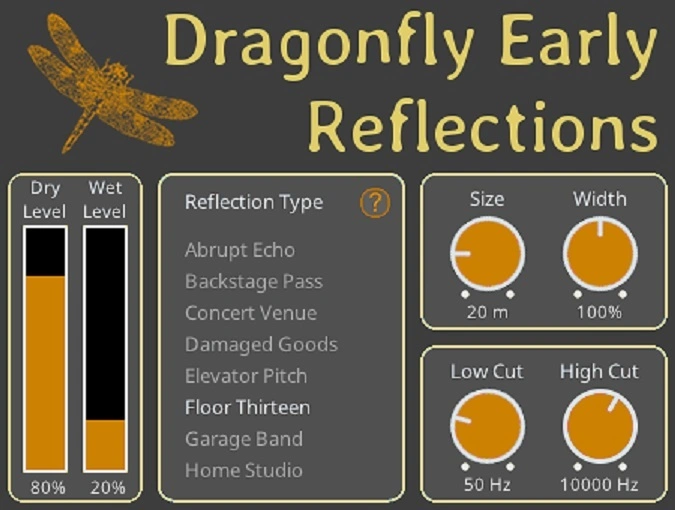
- Eight distinct reflection patterns with unique delay and gain configurations for left and right channels, from concert venues to intimate spaces
- Moorer's early reflection algorithm from Freeverb3 delivers natural-sounding initial reflections without any late reverb tail
- Size control adjusts the simulated space dimensions in meters, allowing precise room matching from small booths to large halls
- Width control shapes stereo spread from narrow mono to expansive stereo imaging for spatial positioning in a mix
- Post-reverb Low Cut and High Cut filters remove unwanted frequencies from the processed signal for a cleaner output
- Color-coded knob interface distinguishes tonal adjustments (orange) from volume adjustments (dark blue) for faster workflow
- Open-source GPL 3.0 plugin with cross-platform support including Linux alongside macOS and Windows
Description
Dragonfly Early Reflections is a dedicated early reflections reverb plugin developed by Michael Willis as part of the open-source Dragonfly Reverb bundle. Built on Moorer's early reflection model from Freeverb3, it isolates the initial sound reflections that occur in a space without adding any late reverberation tail.
This focused approach makes it ideal for adding depth, dimension, and spatial positioning to individual tracks without muddying a mix. The plugin offers eight distinct reflection patterns, each with unique echo delay and gain configurations for left and right channels, providing a wide palette of spatial characteristics.
Controls include Size for adjusting the simulated room dimensions in meters, Width for stereo spread, and independent Dry and Wet level sliders. Post-processing Low Cut and High Cut filters let you sculpt the output to sit cleanly in your frequency spectrum.
The interface uses color-coded knobs to distinguish between tonal adjustments (orange) and volume adjustments (dark blue), making it intuitive to dial in the right amount of space. Users consistently praise the Dragonfly bundle for matching or exceeding the quality of commercial reverbs, with KVR reviewers rating it 5 out of 5 stars.
Dragonfly Early Reflections is available as VST2, VST3, and Audio Unit on macOS, Windows, and Linux, released under the GPL 3.0 open-source license. GUI design is by FistfulOfStars, with the underlying DSP based on Teru Kamogashira's Freeverb3 library.
Video Preview


Tips
- Experiment with different reflection types to find the one that best suits your mix.
- Use the size control to match the simulated space to the desired acoustic environment.
- Adjust the wet and dry levels to blend the reverb effect seamlessly with the original signal.
- Utilize the low cut and high cut parameters to remove unwanted frequencies from the reverb tail.
- Apply the width control to enhance the stereo image of your mix.
- Combine Dragonfly Early Reflections with other reverb plugins for a more complex and layered reverb effect.
- Use the plugin on individual tracks or buses to add depth and dimension to specific elements in your mix.
Frequently Asked Questions
What is the difference between Dragonfly Early Reflections and Dragonfly Hall or Room?
Dragonfly Early Reflections uses the same Moorer's early reflection algorithm found in Dragonfly Hall and Room, but strips away the late reverberation entirely. This gives you only the initial spatial reflections without any sustained reverb tail, making it useful for adding depth and positioning without wash.
What do the eight reflection types actually do?
Each reflection type is a different pattern of echo delays and gain levels for the left and right channels. They simulate different spatial characteristics, though the developer notes the names are primarily meant to be memorable rather than literal descriptions. The Concert Venue type matches the pattern used in Dragonfly Hall and Room.
Does Dragonfly Early Reflections require OpenGL?
Yes, the graphical interface requires OpenGL 3.0 or later. If your system does not support this, the GUI may not display correctly. This is a known consideration on certain Linux configurations and older graphics hardware.
Can I use Dragonfly Early Reflections alongside other reverbs in a chain?
Absolutely. Because it handles only early reflections, it pairs well with a separate late reverb plugin. A common approach is to use Dragonfly Early Reflections for spatial positioning and then feed into Dragonfly Hall or another tail reverb for sustained ambience.