
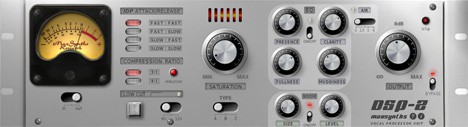
DSP-2
Key Features
- Intelligent Dynamic Processor with four automatic attack/release modes and selectable compression ratio for transparent leveling or aggressive dynamics control
- Three-mode saturator that adds harmonic warmth, tube-style drive, or focused presence depending on the selected operation mode
- Four-band EQ fixed on vocal key frequencies to cut nasal honkiness and add top-end air without surgical tweaking
- Room emulator based on the Schroeder reverberator model for adding natural room ambience directly in the vocal insert chain
- Built-in high-precision input and output VU meters for accurate gain staging across the processing chain
- Low CPU usage suitable for running multiple instances on vocal bus tracks or background harmonies
Description
MaxSynths DSP-2 is a vocal channel strip that combines four processing stages into a single insert: an Intelligent Dynamic Processor, a three-mode saturator, a four-band EQ fixed on vocal key frequencies, and a room emulator based on the Schroeder reverberator. Originally released in 2013 as a commercial plugin priced at EUR 19.90, it became freeware in 2015 when MaxSynths discontinued development.
The compressor section offers four automatic attack/release combinations ranging from fast-fast to slow-slow, with a selectable compression ratio that lets you dial in anything from transparent leveling to aggressive squashing. Rather than exposing dozens of parameters, each stage is tuned for vocal work out of the box.
The saturator provides three distinct operation modes that range from subtle harmonic warmth to aggressive tube-style drive. Users on Plugins4Free (rated 4.4/5 across 22 votes) praise Type B saturation in particular for adding body and presence to both vocal tracks and full mixes at the master bus.
The four-band EQ targets frequencies that matter most for vocal clarity, cutting honkiness in the mids while adding air on top. Combined with the Schroeder reverb for room ambience and the built-in VU metering, DSP-2 handles a complete vocal insert chain without needing multiple plugins.
DSP-2 is a 32-bit Windows VST built with an older version of SynthEdit. It draws minimal CPU, though the 32-bit limitation means you will need a bridge like jBridgeM or 32Lives to run it in modern 64-bit hosts.
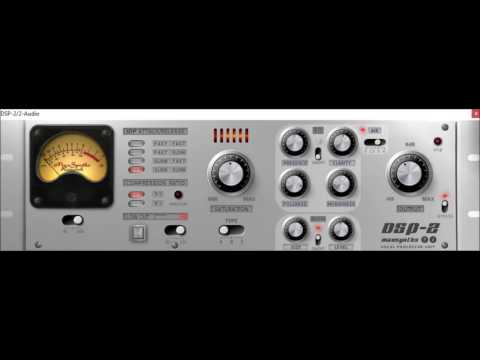
Video Preview
Frequently Asked Questions
Does DSP-2 work in 64-bit DAWs?
DSP-2 is a 32-bit VST plugin only. To use it in a 64-bit DAW you will need a bridging solution such as jBridgeM (Windows) or 32Lives (macOS via Crossover). Some older DAWs like Reaper and FL Studio have built-in 32-bit bridging that may load it directly.
What are the three saturator modes in DSP-2?
The saturator offers three distinct operation modes that range from subtle harmonic enhancement to aggressive tube-style drive. Users frequently highlight Type B saturation as particularly effective for adding body and presence to vocal recordings.
Can DSP-2 be used on instruments other than vocals?
While designed specifically for vocal processing with EQ frequencies tuned to voice fundamentals and harmonics, users report excellent results on percussion loops, drum buses, and even across full mixes at the master bus. The saturator and compressor stages work well on any signal.
Is the compressor in DSP-2 adjustable?
The Intelligent Dynamic Processor provides four automatic attack/release combinations (fast/fast, fast/slow, slow/fast, slow/slow) and a selectable compression ratio. The operative modes are automatic, so you choose the envelope behavior and ratio rather than setting exact millisecond values.


