DuskVerb
Key Features
- Five genuinely different algorithms cover Plate, Hall, Chamber, Room, and Ambient instead of minor preset-style variations
- 16-channel Hadamard feedback delay network with Dattorro-inspired diffusion builds dense and coherent reverb tails
- Decay range from 0.2 seconds to 30 seconds supports both tight spaces and very long atmospheric washes
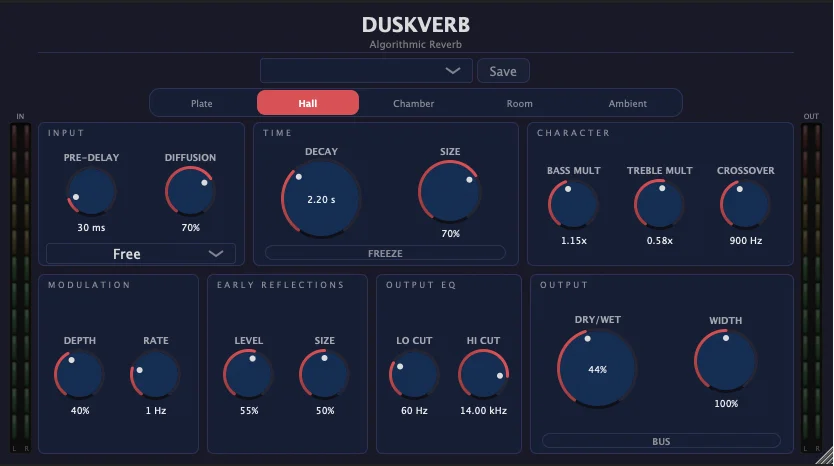
- Character controls include Diffusion, Bass Multiply, Treble Multiply, and Crossover for more detailed tail shaping
- Freeze mode, Bus Mode, stereo width, and output filtering make it useful for both standard mixing and creative sound design
- Cross-platform support includes Windows VST3, macOS VST3 and AU, plus Linux VST3 and LV2 builds
Description
DuskVerb is an open-source algorithmic reverb from Dusk Audio that covers realistic rooms, brighter plates, classic halls, and long ambient washes inside one compact cross-platform plugin. Rather than relying on impulse responses, it builds its spaces with a 16-channel feedback delay network and Dattorro-inspired diffusion, which gives it a more deliberately designed, synthetic architecture.
That underlying engine matters because the five modes are not simple preset variations. Plate, Hall, Chamber, Room, and Ambient each use different delay structures, so moving between them feels like switching reverb personalities rather than just changing decay time or EQ.
The control layout is also stronger than you might expect from a new free release. Decay reaches from short 0.2-second spaces to 30-second tails, while Diffusion, Bass Multiply, Treble Multiply, Crossover, modulation, stereo width, and cut filters let you shape both the density and tone of the tail in a meaningful way.
BPB highlighted Ambient as the standout for drones and cinematic textures, but DuskVerb is broader than that. The Room and Hall algorithms handle more conventional duties, and the Freeze button plus Bus Mode make it useful both as an insert effect and as a send-style reverb for bigger sound-design moves.
If you want an algorithmic reverb that feels more engineered than generic, DuskVerb punches well above typical freeware expectations. Its open-source status and direct no-signup downloads are nice bonuses, but the real appeal is that it sounds like a focused reverb design rather than a feature checklist.
Frequently Asked Questions
What makes DuskVerb different from a basic stock reverb?
Its five modes are built on different underlying delay structures rather than simple tone presets. That gives Plate, Hall, Room, Chamber, and Ambient noticeably different space and tail behavior, especially once you start using the character controls.
Is DuskVerb better for realistic spaces or atmospheric effects?
It can do both, but the strengths shift by algorithm. Room and Hall make the most sense for conventional ambience, while Ambient and Freeze are where it starts leaning into drones, pads, and cinematic texture work.
Does DuskVerb support Linux?
Yes. Dusk Audio provides Linux builds alongside Windows and macOS, and the Linux release supports both VST3 and LV2 formats. BPB also notes the current Linux requirement as glibc 2.31 or newer.
Can I use DuskVerb as a send effect?
Yes. The plugin includes a Bus Mode that sets it up for wet-only send/return use, and the Freeze function can hold the current tail indefinitely for more experimental reverb layers.