
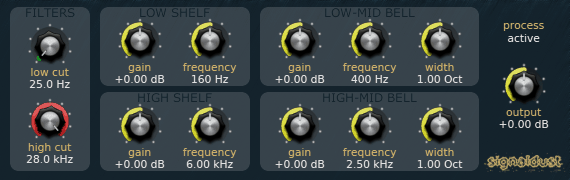
Dust Equalizer
Key Features
- Six-band channel EQ with high/low cut filters, shelving filters, and two parametric bell bands
- Butterworth filter design delivers a flat passband without significant ringing or resonance
- Asymmetric shelf curves with sharper knee toward midrange and gradual roll-off at the extremes
- Gain-bandwidth interaction on bell filters maintains perceptually even boost and cut across Q settings
- Analog-modeled phase and amplitude response without oversampling since version 1.7.0
- Knob-only interface with no visual frequency graph, encouraging mix decisions by ear
- Extremely lightweight on CPU resources with a download size under 1 MB
Description
Dust Equalizer by Signaldust is a channel equalizer plugin built around the principle of simplicity. It provides a pair of high and low cut filters, a pair of shelving filters, and two mid-frequency bell filters, giving you six bands of clean tonal control without visual distractions.
The filters use a Butterworth design for a flat passband with minimal ringing, while the shelves feature a custom asymmetric shape that transitions more sharply toward the midrange and more gradually toward the frequency extremes. The bell filters use classic log-symmetric curves with gain-bandwidth interaction, meaning the perceived boost or cut stays consistent as you widen or narrow the Q.
Users consistently praise its transparency and low coloration, noting that it lets the original character of the source material come through with only the intended corrections applied. The knob-only interface encourages ear-first mixing rather than visual reliance on frequency graphs.
Since version 1.7.0, Dust Equalizer no longer uses oversampling and instead matches the analog target in both amplitude and phase response. The result is a lightweight, CPU-friendly EQ that approximates analog behavior at all audible frequencies.
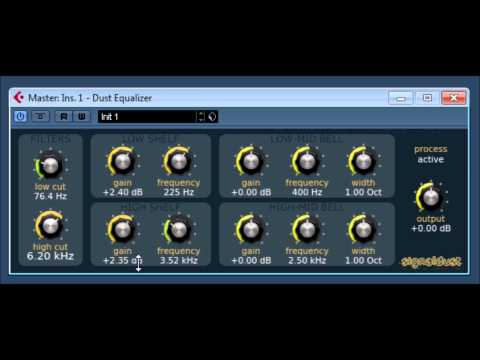
Video Preview
Frequently Asked Questions
Is Dust Equalizer available for macOS or 64-bit systems?
Dust Equalizer is available as both a 32-bit and 64-bit VST plugin, but it is Windows-only. There is no macOS or AU version available. If you need cross-platform support, you would need a different EQ plugin.
How does the gain-bandwidth interaction on the bell filters work?
When you set a narrow bandwidth, the actual peak gain is higher. As you widen the bandwidth, the peak gain decreases. This design keeps the perceived loudness change roughly consistent regardless of how wide or narrow you set the Q, which makes it more intuitive to use than conventional parametric EQs.
Does Dust Equalizer add coloration or harmonic saturation to the signal?
No. Dust Equalizer is designed to be transparent and clean. Users describe it as one of the most transparent EQs available, imparting very little character of its own. It is built for corrective work rather than tonal coloration.


