
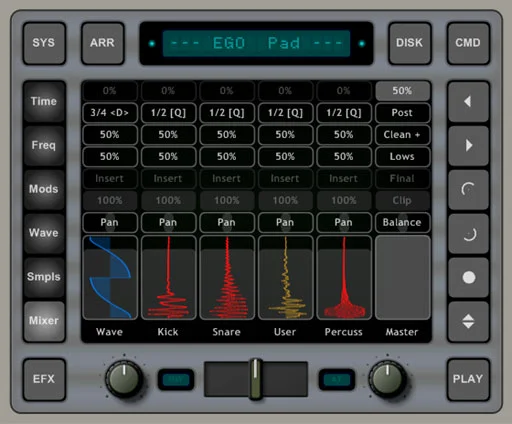
EGO Pad
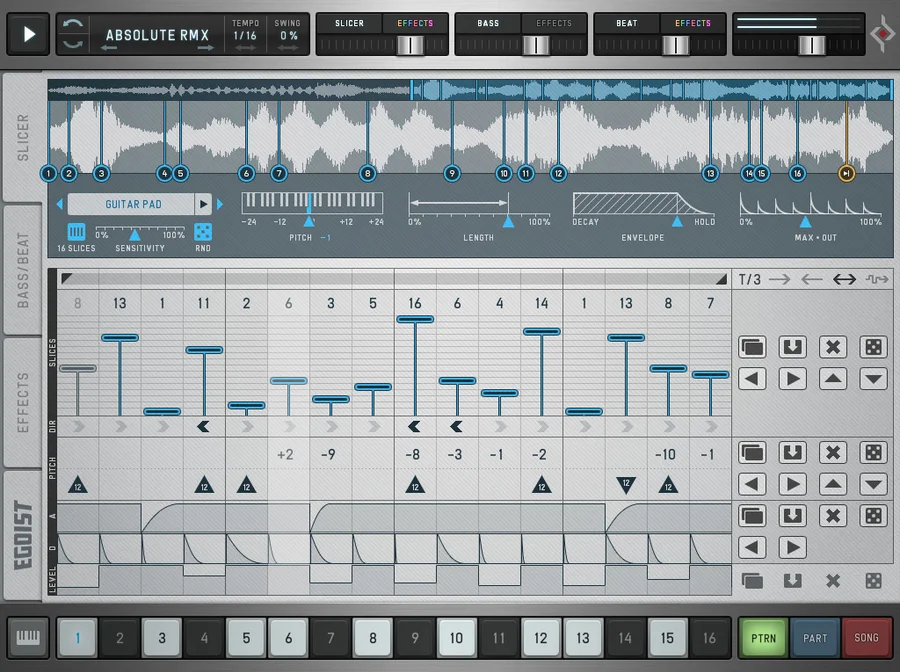
Key Features
- Cell-based rows-and-columns sequencer supports real-time pattern editing, copying, pasting, and randomization.
- Legacy Laser Motion view gives an alternate visual performance mode alongside the newer pad-style interface.
- Modular routing connects sequences to synthesis and effects sections for more varied pattern-driven sound design.
- Wave track can use fixed wavetable ROMs and CARDs, drawable mathematical wavetables, and sample-generated wavetables.
- Four-track drum machine includes 16-step sequence editing, conditional steps, and 25 MB of curated samples.
- Hundreds of rhythms from the discontinued Acrobatics Clave VSTi project expand the built-in groove material.
- Analysis graphs follow the synthesis process so users can see how a program is being built.
Description
EGO Pad is a Windows VSTi groovebox from Acrobatics that combines cell-based sequencing, synth generation, effects routing, and a compact four-track drum machine inside one old-school instrument. The current official Acrobatics listing shows Pad Version 2.6.0 as a 32-bit freeware download, with the product framed as an Electronic Groove Operator rather than a conventional drum rompler.
The main workflow is built around rows-and-columns sequencing plus a command section for editing, copying, pasting, and randomizing patterns in real time. A Laser Motion view is still available from the earlier EGO design, so the plugin keeps both the newer pad-style grid and the more visual motion-based approach.
EGO Pad is more modular than its retro interface suggests. The wave track can draw from fixed wavetable ROMs and CARDs, mathematically generated drawable wavetables, and sample-generated wavetables, then route sequence data into synthesis and effects sections in different ways.
The drum side adds four sequence tracks, 16-step editing, conditional steps, and 25 MB of curated samples. It can also use hundreds of rhythms carried over from the discontinued Acrobatics Clave VSTi project, making it useful for fast electronic sketches, mini-songs, and unusual pattern experiments.
The catch is compatibility. Acrobatics built EGO Pad with SynthMaker/Flowstone, and both the official page and KVR discussion point to 32-bit Windows VSTi hosts, with bridging likely needed in many modern 64-bit DAWs.
Video Preview

Frequently Asked Questions
Is EGO Pad a synth, a drum machine, or a groovebox?
It is best treated as a groovebox-style VST instrument. The official page combines wavetable and sample-generated synthesis with sequence routing, effects, and a four-track drum machine, so it is broader than a simple drum rompler.
Does EGO Pad work in modern 64-bit DAWs?
The official Acrobatics page lists EGO Pad as 32-bit, and KVR lists the system requirement as any 32-bit VSTi host. Modern 64-bit Windows DAWs may need a bridge such as jBridge, so compatibility is the main review risk.
What changed in the newer EGO Pad versions?
The BPB article highlights the newer pad-based interface, real-time command section, and a more modular approach to combining sequences with synthesis and effects. The official page currently lists Pad Version 2.6.0 and still keeps the older Laser Motion view available.
What kind of source material is included?
Acrobatics says the drum machine uses 25 MB of selected samples, while KVR notes that EGO Pad can load or save 16-bit WAV material and wavetables. It also includes many rhythms ported from the discontinued Acrobatics Clave VSTi project.


