
Emissary
Key Features
- Dual-channel tube amp emulation with independent clean and high-gain lead channels modeled from a real custom amplifier circuit
- Version 2.0 engine rebuilt from the ground up using advanced non-linear differential equation solving for more accurate tube simulation
- Bundled with NadIR 2.0 zero-latency dual cabinet IR loader and 6 included impulse responses for immediate use
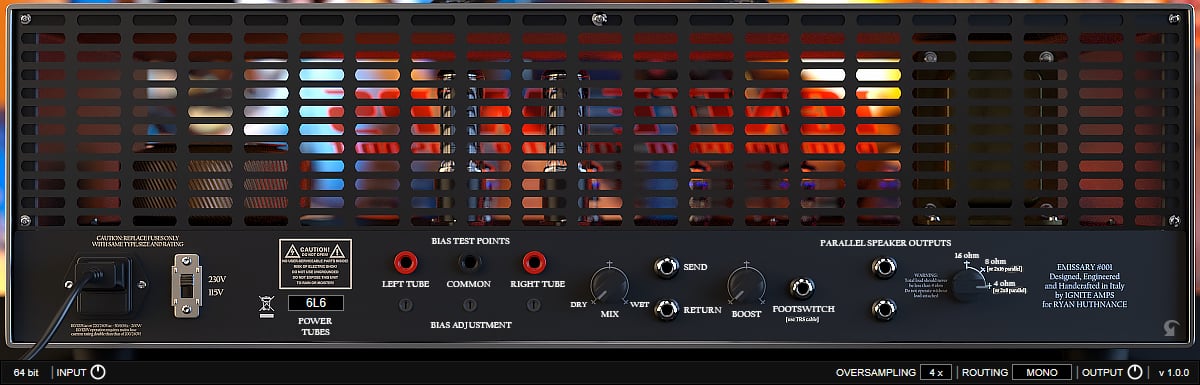
- Photorealistic 3D-rendered GUI modeled after the physical Emissary amplifier hardware
- Low CPU footprint designed for real-time playability during live performance and tracking sessions
- Wide tonal range from pristine cleans through subtle overdrive to extreme high-gain metal distortion
- Available in VST, VST3, AU, and AAX formats with both 32-bit and 64-bit support
Description
Emissary by Ignite Amps is a dual-channel guitar tube amplifier emulation modeled after a custom amp built for Ryan Huthnance of The Seer, Chrome Bison, and Emissary Studios. Originally released in 2014 and rebuilt from the ground up for version 2.0 in partnership with STL Tones, it uses state-of-the-art analog modeling technology based on non-linear differential equations derived directly from the original circuit schematics.
The clean channel delivers everything from pristine sparkle to lightly driven warmth, while the lead channel is purpose-built for aggressive, bone-crushing high-gain tones. Every component on the signal path of the real analog circuit has been accounted for and modeled to match the original sound while maintaining low CPU usage and real-time playability.
The Emissary 2.0 bundle includes the NadIR 2.0 dual cabinet impulse response loader with zero latency, plus six included impulse responses to get started immediately. NadIR provides advanced built-in filters and delay controls for further tone shaping.
Guitarists consistently rank Emissary among the top amp simulators regardless of price, praising its realistic tube feel and ability to produce mix-ready tones when paired with quality cabinet IRs. It handles everything from modern metal and djent to classic rock overdrive, making it a go-to plugin for players who want authentic tube amplifier behavior in their DAW.
The plugin GUI was 3D modeled and rendered by Voger Design to closely resemble the physical amplifier. It supports VST, VST3, AU, and AAX formats in both 32-bit and 64-bit versions on macOS and Windows.
Video Preview


Frequently Asked Questions
Is Ignite Amps Emissary any good?
Emissary is widely considered one of the best amp simulators available at any price point. Guitarists on forums and review sites consistently praise its realistic tube response and ability to produce professional-quality high-gain tones. Paired with quality cabinet impulse responses, it competes directly with paid amp sims costing $100 or more.
What is the difference between Emissary 1.0 and 2.0?
Emissary 2.0 was completely rewritten from the ground up with a new tube simulation engine developed in partnership with STL Tones. The updated version uses more advanced analog modeling algorithms for improved accuracy and sound quality. It also added AAX format support and comes bundled with the NadIR 2.0 cabinet IR loader.
Do I need a cabinet IR loader to use Emissary?
Yes, Emissary is an amplifier-only simulation and does not include built-in cabinet modeling. However, the download bundle includes NadIR 2.0, a zero-latency dual IR loader, along with 6 impulse responses so you can get started right away. You can also load third-party IRs for more tonal options.
Can Emissary produce clean tones or is it only for metal?
While Emissary is best known for its high-gain lead channel, it also features a highly versatile clean channel. The clean channel ranges from pristine, bell-like cleans to subtle edge-of-breakup overdrive tones suitable for blues, jazz, and rock styles.


