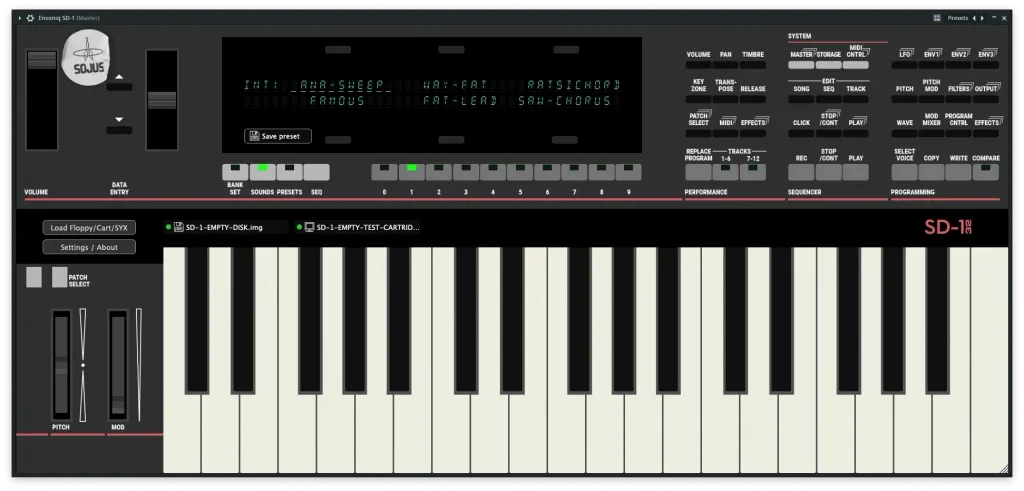
Ensoniq SD-1/32 VST Emulation
Key Features
- Cycle-accurate MAME engine keeps the SD-1’s distinctive digital layering, filter behavior, effects section, and workstation feel much closer to the original hardware than a loose inspired-by synth
- Single patches can combine up to six ROM waves, which makes it strong for glassy hybrid pads, metallic motion, digital pianos, stacked textures, and late-80s to early-90s workstation tones
- Media loading goes beyond preset playback by supporting original floppy and cartridge content plus VFX, VFX-SD, and SD-1 resources for users with legacy Ensoniq libraries
- Full automation, MIDI CC control, polyphonic aftertouch support, and multiple panel layouts make the emulation more usable in a modern DAW than many preservation-first ports
- Latest v0.9.9 builds remove the old single-instance limit and add a dedicated SAVE PRESET macro, making bigger arrangements and repeatable workflow easier
- Cross-platform releases now cover Windows, macOS, and Linux, with both VST3 and a selected-DAW AU path on Mac for users who need tighter host integration
Description
Ensoniq SD-1/32 VST Emulation is a cycle-accurate software recreation of Ensoniq’s 1990 workstation synth from Sojus Records, built to bring the original instrument’s layered digital character into modern DAWs. Instead of approximating the vibe with a simplified front end, it leans into the SD-1’s full identity: stacked waveforms, evolving hybrid textures, onboard effects, and the workstation-style sequencing attitude that made the hardware memorable in the first place.
The core engine is based on MAME, so a single patch can still combine up to six waves from the original ROM set while running through the SD-1’s dual filters, deep envelope structure, modulation sources, and internal effects. It also goes beyond a static preset-player approach by supporting floppy and cartridge media loading, VFX and VFX-SD compatibility, and SysEx import for users who already have old Ensoniq banks they want to revive.
That authenticity is the main draw, but the plugin is not stuck in museum mode. The current v0.9.9 release adds unlimited instances, full automation for buttons and sliders, multiple panel layouts with a resizable GUI, and a new preset-save macro, so it feels more workable inside a present-day session than many retro emulations that stop at nostalgia.
It is still presented by Sojus Records as a free and open-source project, with current downloads published on the official GitHub releases page for Windows, macOS, and Linux. The catch is that you must supply the required SD-1 ROM files yourself, and the new macOS AU build is limited to selected DAWs, so this suits producers who want the real workstation behavior and are willing to handle a slightly more involved setup.
Video Preview

Frequently Asked Questions
Does the plugin include the original SD-1 ROM files?
No. Sojus Records is explicit that the required Ensoniq ROM files are not bundled for copyright reasons, so the plugin will not boot fully until you supply the exact `sd132.zip` ROM set yourself.
Is this a lightweight synth or a heavy emulation?
It is a hardware-level emulation and Sojus warns that it places heavy demands on the CPU. If you hear underruns, their guidance is to raise the plugin buffer setting rather than expecting the same overhead as a simple modern wavetable synth.
Can it load original SD-1 banks, cartridges, and SysEx files?
Yes. The current official materials say it can load compatible floppy and cartridge media, import VFX and VFX-SD content, and pull in `.syx` SysEx banks so existing Ensoniq libraries stay useful.
Does the latest version support multiple instances?
Yes. The v0.9.9 release notes say the old instance limit was removed, so you can now load multiple copies in the same project instead of being restricted to a single active instance per DAW session.
What should Mac users know about the AU build?
The first public AU build arrives in v0.9.9, but Sojus limits it to Logic, GarageBand, MainStage, Ableton Live, Fender Studio Pro, and Reaper. If your DAW is outside that list, the safer choice is the macOS VST3 build.