Explorer
Key Features
- Four-oscillator engine with sine, triangle, sawtooth, and square waveforms on oscillators 1-3 and a white/pink noise generator on oscillator 4
- Five waveshaping algorithms (basic, sync, phase distortion, stretch, flip) plus phase and ring modulation between oscillators for deep sound design
- Up to 128-voice polyphony (64 voices per oscillator) enabling massive unison stacks, layered pads, and complex textures
- Comprehensive filter with 10 modes including lowpass, highpass, bandpass, notch, comb, and shelving filters, each with a drive stage
- Three DAHDSR envelopes and three LFOs with modulation routing to every parameter via velocity, aftertouch, and assignable controllers
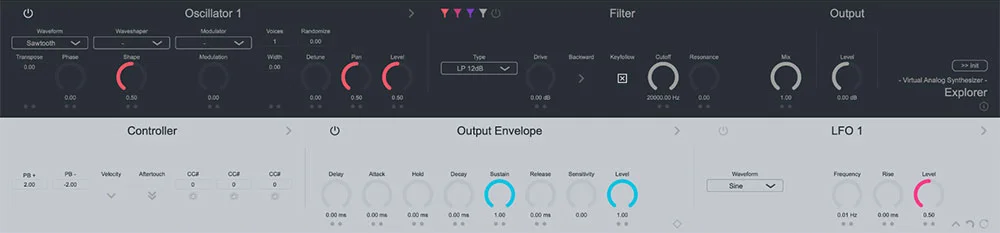
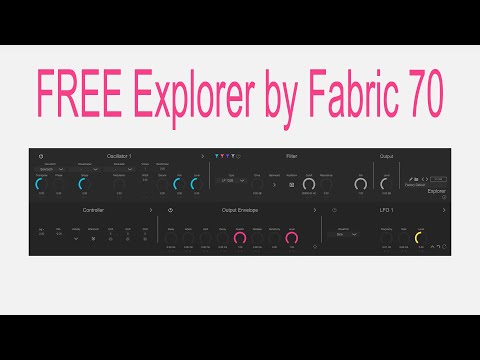
- Dark, wide-panel interface with color-coded knobs and logical grouping that keeps all controls on a single screen
Description
Explorer by Fabric 70 is a polyphonic synthesizer built around four oscillators and an extensive waveshaping engine. The first three oscillators each provide sine, triangle, sawtooth, and square waveforms with five shaping algorithms — basic, sync, phase distortion, stretch, and flip — plus phase and ring modulation between them.
The fourth oscillator is a dedicated noise generator offering white and pink noise with its own filter. Each oscillator supports up to 64 voices, giving Explorer a maximum polyphony of 128 voices for layered pads and dense textures.
The filter section covers lowpass, bandpass, highpass, notch, peak, allpass, low shelf, high shelf, and both positive and negative comb modes, all with a drive control for added harmonic warmth. Three DAHDSR envelopes and three LFOs handle modulation, routable to every parameter via velocity, aftertouch, and three assignable controllers.
Developed in Osaka, Japan by Ken Ito and Yasutaka Kanewaka, Explorer is built on the JUCE framework and runs as a VST3 or Audio Unit plugin. The interface uses a dark color scheme with color-coded knobs and a wide panel layout that keeps every control visible without menu diving.
Some users have noted elevated CPU usage under heavy polyphony. Reducing the voice count or freezing tracks in your DAW can help manage the load in larger sessions.
Video Preview

Frequently Asked Questions
What waveshaping modes does Explorer offer?
Explorer provides five waveshaping algorithms — basic, sync, phase distortion, stretch, and flip — that reshape oscillator waveforms before they reach the filter. You can also apply phase or ring modulation between oscillators 1-3 for additional harmonic complexity.
How many voices of polyphony does Explorer support?
Each of the four oscillators can run up to 64 voices, giving a theoretical maximum of 128 simultaneous voices. This makes it capable of thick unison leads and wide stacked pads, though higher voice counts will increase CPU demand.
Does Explorer have high CPU usage?
Several users have reported higher-than-average CPU consumption, especially at full polyphony. Lowering the voice count per oscillator and using track freezing in your DAW are effective ways to manage performance in complex sessions.
What filter types are available in Explorer?
The filter section includes lowpass, bandpass, highpass, notch, peak, allpass, low shelf, high shelf, and both positive and negative comb filters. A drive knob adds harmonic saturation before or after filtering, letting you shape tone from clean to gritty.