
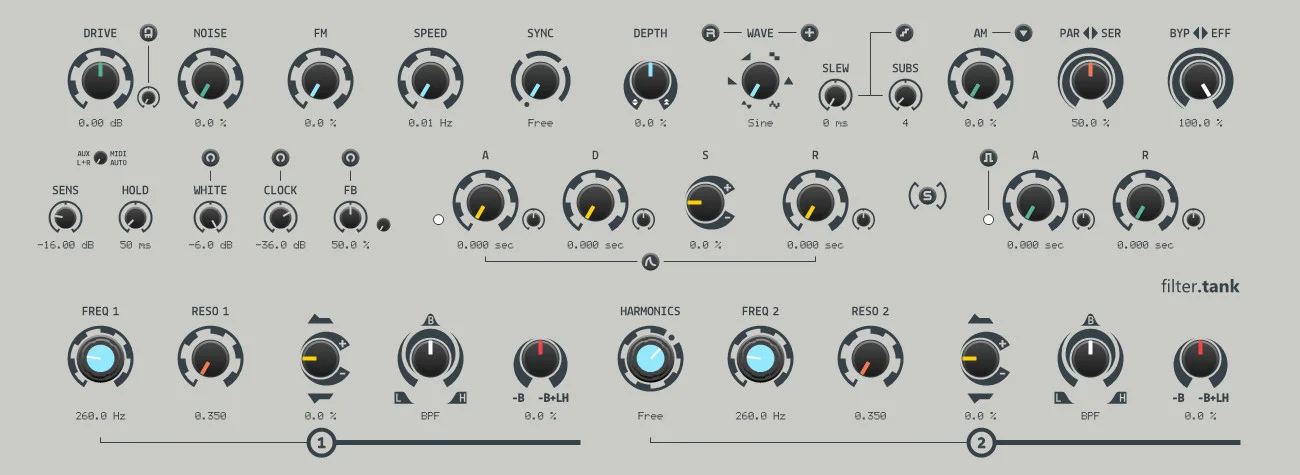
filter.tank
Key Features
- Dual-filter design aimed at aggressive hardware-style resonant sweeps rather than transparent corrective filtering
- Character-first workflow that can move from subtle tone shaping into unstable, feedback-like extremes for transitions and sound design
- Inspired by the same performance-driven territory as the Sherman Filterbank 2, but packaged as a compact in-the-box effect
- Tiny 150 KB footprint keeps the plugin lightweight enough for quick use on loops, synths, drums, and resampling chains
- Included manual from the developer helps explain the control layout despite the plugin's experimental design
- 64-bit Windows VST format keeps installation simple for dedicated Windows production setups
Description
filter.tank is a compact Windows filter effect from Sender Spike that turns static sounds into aggressive, unstable sweeps with the attitude of a Sherman-style hardware filterbank. Rather than aiming for a precise clone, it focuses on the same kind of driven dual-filter movement, self-oscillation, and edge-of-feedback behavior that makes external filter boxes so playable.
The plugin combines two filter stages with modulation controls that push simple loops, drums, and synth lines into animated resonant motion. Bedroom Producers Blog notes that it can move from useful tone shaping into wild, speaker-threatening extremes very quickly, which matches Sender Spike's own positioning of the effect as a character processor instead of a polite mixing filter.
This makes filter.tank most useful when you want filtering to become the event, not just a cleanup tool. Sweeping resonance, saturating the signal path, and driving the output into unstable territory can add the kind of physical, performance-style motion that standard in-the-box filters often miss.
The trade-off is scope. filter.tank is a tiny 64-bit Windows VST with no broad cross-platform support, and it rewards cautious gain staging because the resonant peaks can get brutally loud.
If you want a lightweight effect for distorted sweeps, feedback-heavy transitions, and rough analog-style motion on electronic material, filter.tank fills that role with very little setup and almost no footprint.
Frequently Asked Questions
Is filter.tank an exact Sherman Filterbank 2 emulation?
No. Sender Spike explicitly frames it as a plugin that lands in the same ballpark rather than a strict one-to-one emulation. The appeal is the same kind of driven dual-filter attitude and performance-style motion, not a component-accurate recreation.
Why do people warn about the output level?
Bedroom Producers Blog highlighted that filter.tank can produce very loud and extreme resonant peaks, especially when you start pushing it for character. It is sensible to insert a limiter after it and keep monitoring levels conservative while exploring the more aggressive settings.
What systems does filter.tank support?
The available release is a Windows-only 64-bit VST plugin. There is no macOS, Linux, AU, or VST3 build listed on the official product and downloads pages.
What kinds of sounds suit filter.tank best?
It is better suited to creative processing than transparent mixing work. Electronic drums, synth basses, loops, risers, and resampling chains make the most sense because the plugin's strong resonance and motion become part of the arrangement.


