Flying-Reverb
Key Features
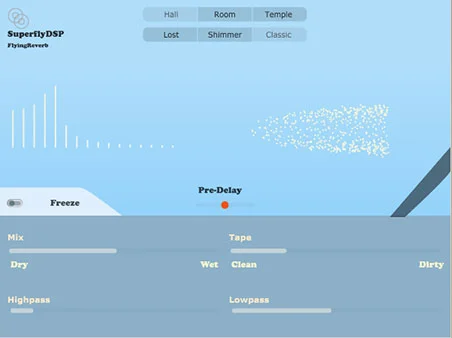
- Three space types (Hall, Room, Temple) combined with three characters (Classic, Shimmer, Lost) for nine distinct reverb profiles
- Shimmer mode with pitch-shifted harmonics for ethereal, celestial atmospheres on pads, guitars, and vocals
- Host-syncable pre-delay that locks reverb timing to session tempo for rhythmically precise spatial effects
- Freeze function that sustains the current reverb tail indefinitely, turning any input into dense evolving textures
- Built-in highpass and lowpass filters at 12 dB per octave for shaping the wet signal without external processing
- Tape saturation on the wet signal for adding warmth and harmonic density to reverb tails
- Low CPU usage with a resizable GUI featuring real-time spectrum visualization of input and reverb output
Description
Flying-Reverb by SuperflyDSP is a multi-mode algorithmic reverb plugin offering three distinct space types and three tonal characters, making it unusually versatile for a lightweight effect. It covers everything from tight rooms and wide halls to synthetic temple spaces, each available in Classic, Shimmer, or Lost mode.
The Classic character delivers clean, transparent reverb tails suited to everyday mixing. Shimmer adds pitch-shifted harmonics for ethereal, celestial textures ideal for ambient pads and swelled guitar leads, while Lost pushes the shimmer concept further with intentional artifacts for experimental sound design.
Early reflections are independently adjustable for both amplitude and duration, giving precise control over how a space builds up. A host-syncable pre-delay locks reverb timing to your session tempo, and the built-in highpass and lowpass filters at 12 dB per octave let you sculpt the frequency content of the wet signal without reaching for a separate EQ.
Tape saturation on the wet signal adds warmth and harmonic density when pushed, while the freeze function captures and sustains the current reverb tail indefinitely for dense, evolving soundscapes. The resizable interface includes a real-time spectrum display that visualizes the reverb output alongside the input signal.
Flying-Reverb runs as VST3 and AU on Windows, macOS (Universal Binary supporting both Apple Silicon and Intel), and Linux, requiring only a 64-bit host.
Video Preview


Frequently Asked Questions
What is the difference between Shimmer and Lost mode in Flying-Reverb?
Shimmer mode adds pitch-shifted harmonics to the reverb tail, creating ethereal and celestial textures well suited for ambient pads and guitar swells. Lost mode takes the same pitch-shifting concept but introduces intentional digital artifacts, producing a more experimental, lo-fi character useful for sound design and textural work.
Can I freeze the reverb tail to create sustained drones and textures?
Yes, Flying-Reverb includes a freeze function that captures and holds the current reverb tail indefinitely. This lets you play into the frozen reverb to build dense, evolving soundscapes without needing a separate looping or granular tool.
Does Flying-Reverb support tempo-synced pre-delay?
Yes, the pre-delay can be synchronized to your DAW's host tempo. This ensures reverb onset aligns rhythmically with your session, which is particularly useful for keeping spatial effects tight on percussive and rhythmic material.
How does Flying-Reverb compare to Valhalla Supermassive?
While Valhalla Supermassive focuses on massive delays and reverbs with feedback-based algorithms, Flying-Reverb offers a more traditional reverb structure with dedicated room, hall, and temple spaces plus a true shimmer mode with pitch shifting. Flying-Reverb also includes tape saturation and independent early reflection controls that Supermassive does not have.