
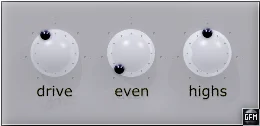
GFM Distort

Key Features
- Applies a focused digital saturation and distortion character without a large multi-stage signal chain.
- Uses 16x oversampling to reduce aliasing while pushing harmonic coloration.
- Combines deliberate instability and a low-pass post-filter for a distinctive late-1990s digital tone.
- Works well for warming or roughening drums, guitar parts, and acid-style leads.
- Offers a simple route from light saturation to more pronounced gritty distortion.
- Provides native VST and Audio Unit editions for Windows and macOS from Auburn Sounds.
Description
GFM Distort is Auburn Sounds' legacy digital saturation and distortion effect for adding direct harmonic edge to tracks. Its compact, fixed-purpose design is aimed at broad coloration rather than a deep collection of modeled circuits, with a low-pass post-filter and built-in instability contributing to its intentionally late-1990s character.
The developer specifies 16x oversampling, giving the plug-in a cleaner high-drive path than many simple early digital distortion effects. It is a strong fit for warming drums, guitars, and acid-style leads, where the source can take a little grit without needing an elaborate multiband or amp-simulation workflow.
GFM Distort can move from restrained saturation into a more obvious digital rasp, so level-matching the bypassed signal is useful when judging its effect. Start conservatively on full-range material, then use the post-filter to keep added harmonics from becoming brittle or overly busy in a dense arrangement.
This is a legacy release rather than an actively maintained current plug-in. Auburn Sounds still provides a dedicated product page and its own public download button for the full version, but explicitly says the plug-in is unsupported and will not receive updates.
Frequently Asked Questions
What kind of effect is GFM Distort?
GFM Distort is a digital saturation and distortion effect. Its design is deliberately compact and uses oversampling, instability, and a low-pass post-filter to create a characterful 1990s-leaning result.
What sources suit GFM Distort best?
Auburn Sounds specifically suggests drums, guitar, and acid leads. It is useful when a part needs broad warming or grit instead of a detailed amp, cabinet, or multiband processing chain.
What does the 16x oversampling do?
The developer describes GFM Distort as using 16x oversampling to keep aliasing low. In practice, that supports driving the effect while retaining a cleaner high-frequency result than a basic un-oversampled digital shaper.
Is GFM Distort still maintained?
No. Auburn Sounds labels it as unsupported and says it will not receive support or updates. The official dedicated page still offers the full version, so it remains available as a legacy release.


