InfernalSynth
Key Features
- Four oscillators with five generator types including classic waveforms, noise, DSF harmonic synthesis, and Karplus-Strong physical modelling
- Twenty effect slots with state-variable filters, comb filters, oversampled waveshapers, delay, and reverb across per-voice and global chains
- Flexible CV matrix routing envelopes, LFOs, velocity, keyboard tracking, and MIDI CC to nearly any continuous parameter with sample-accurate modulation
- Dual operating modes providing a full polyphonic synthesizer (up to 32 voices) and a standalone effect processor for external audio
- Comprehensive oscillator modulation with phase, frequency, ring, and amplitude modulation plus hard sync and adjustable unison with stereo spread
- DAHDSR envelopes with sustain, follow, and release modes alongside multi-shape LFOs with custom free-form drawing and random generators
- Open-source codebase with themeable JSON-based interface, built-in CPU monitoring, and per-module performance breakdown
Description
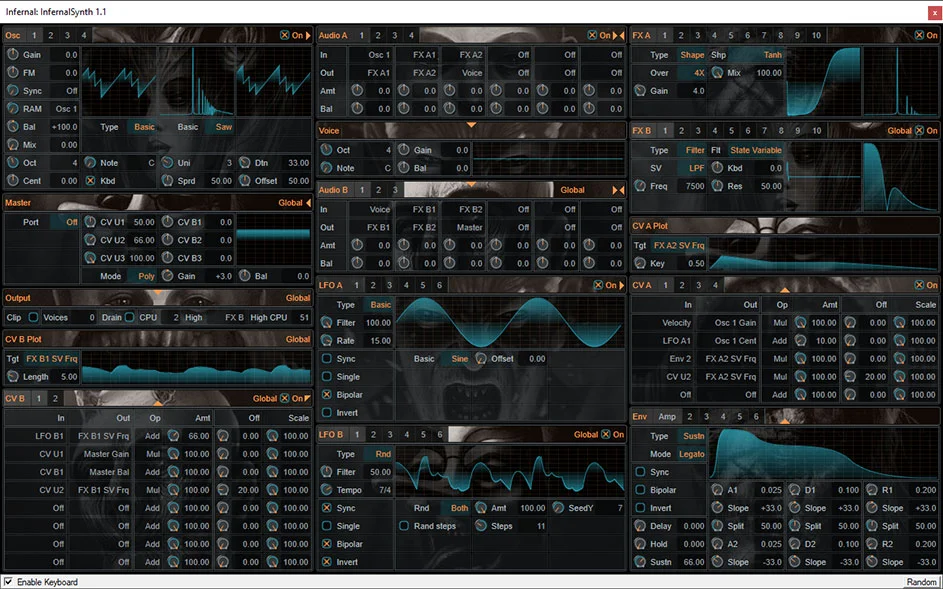
InfernalSynth is an open-source semi-modular synthesizer and effect plugin built by Sjoerd van Kreel. It ships as separate instrument and effect binaries, giving you a full polyphonic synth with up to 32 voices alongside a standalone effects processor that routes external audio through the same global effect bank.
The synth section offers four oscillators spanning five generator types: classic waveforms (sine, saw, triangle, pulse), mix mode for blending generators, noise with spectral shaping, DSF for layered harmonic content, and Karplus-Strong for physical-modelling string and plucked tones. Each oscillator supports phase modulation, frequency modulation, ring modulation, amplitude modulation, hard sync, and adjustable unison with stereo spread.
Routing is where InfernalSynth sets itself apart from typical subtractive synths. Twenty effect slots split between per-voice and global processing accept state-variable filters, comb filters, waveshapers with oversampling, delay, and reverb.
A flexible CV matrix lets envelopes, LFOs, velocity, keyboard tracking, and MIDI CC modulate nearly every continuous parameter with sample-accurate precision. This modular-level control makes it possible to create patches that rival dedicated hardware modulars in complexity.
Users on KVR praised the core oscillator and filter sound quality, noting that the synth excels at FM and PM timbres, aggressive distortion textures, and deep modular-style patches. The interface is dense and rewards patient exploration, though the developer acknowledged the layout can feel overwhelming at first.
InfernalSynth requires 64-bit Windows 7 or later with a CPU that supports AVX instructions. The project is now archived, having been superseded by Firefly Synth, but InfernalSynth remains a fully functional and powerful sound-design tool in VST3 and CLAP formats.
Frequently Asked Questions
Does InfernalSynth work as both a synthesizer and an effect plugin?
Yes. InfernalSynth ships as two separate binaries. The instrument version is a full polyphonic synth with up to 32 voices routed through a global effect bank. The effect version bypasses the oscillators entirely and routes external audio through the same global effects chain, making it useful as a multi-effect processor inside your DAW.
Is InfernalSynth still being developed?
No. The developer archived the project in January 2026 and moved to its successor, Firefly Synth, which offers the same synthesis engine with a redesigned interface and cross-platform support. InfernalSynth remains fully functional and available for download, but no further updates are planned.
Does InfernalSynth require AVX CPU support?
Yes. InfernalSynth requires a 64-bit CPU with AVX instruction support. Most CPUs manufactured after 2011 include AVX, but older processors like early Core 2 Duo or Athlon models will not run the plugin. You can check your CPU specs in Windows System Information.
How steep is the learning curve compared to typical synths?
InfernalSynth is significantly more complex than a standard subtractive synth. Its twenty effect slots, four oscillators, and deep CV matrix routing give it modular-level flexibility, but the dense interface requires patience. The included presets and GitHub manual help, and KVR community members have shared patches through the One Synth Challenge that demonstrate its range.