
JAMP
Key Features
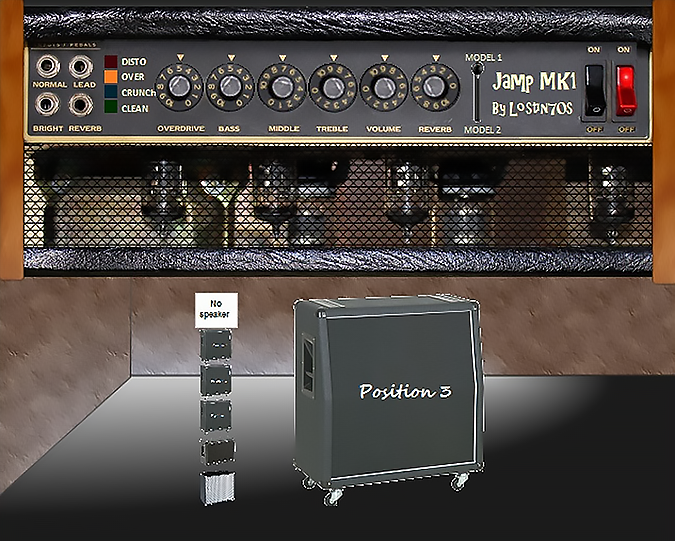
- Four gain channels (clean, crunch, overdrive, distortion) covering everything from sparkling cleans to heavy saturation
- Real tube circuit emulation that responds dynamically to guitar volume changes like a physical amplifier
- Five built-in cabinet emulations modeling the spectral characteristics of different speaker configurations
- Two convolution-based spring reverb models with adjustable depth for adding room character
- Pre-gain and stack equalizer controls for precise tone shaping before and after the amp stage
- Convolution engine rewritten in v1.3 for half the CPU usage on spring reverb processing
- Supports 44.1 kHz, 48 kHz, and 96 kHz sample rates in both 32-bit and 64-bit VST formats
Description
JAMP MK1 by Lostin70s is a guitar amplifier simulator built on real tube circuit emulation. It delivers four distinct gain channels — clean, crunch, overdrive, and distortion — that respond dynamically to your guitar’s volume knob, just like a physical tube head.
The plugin ships with five switchable cabinet emulations that model the spectral characteristics of real speaker enclosures. Two convolution-based spring reverb models are included with adjustable depth, adding room and ambiance without needing a separate reverb plugin.
A pre-gain control lets you dial in the exact amount of drive before the amp stage, while a built-in stack equalizer shapes your overall tone. The cabinet simulation focuses purely on frequency response rather than room reflections, which keeps the tone tight and defined in a mix context.
JAMP sits well in a signal chain alongside other plugins. You can stack compressors, boost pedals, or additional distortion before it and the amp reacts naturally, much like plugging into a real tube amplifier.
The convolution engine was rewritten in version 1.3, cutting spring reverb CPU usage in half. JAMP supports 44.1 kHz, 48 kHz, and 96 kHz sample rates and is available in both 32-bit and 64-bit VST formats for Windows.
Video Preview

Frequently Asked Questions
Why does JAMP sound dry through headphones?
The cabinet simulation models only the spectral characteristics of the speaker, not room reflections. Through headphones you hear this directly, which can sound dry. In a mix or played through monitors in a real room, the tone sits more naturally.
Can I use third-party impulse responses with JAMP?
Yes. You can turn off JAMP's built-in cabinet simulation and load a separate IR loader plugin after it in your signal chain. This lets you use any third-party cabinet impulse response for more tonal variety.
Does JAMP work well with other effects plugins in the chain?
JAMP is designed to accept plugins before it in the signal chain, including compressors, boost pedals, and external distortion. It reacts to input level changes naturally, similar to how a real tube amp responds to a pedalboard.
What sample rates does JAMP support?
JAMP supports 44.1 kHz, 48 kHz, and 96 kHz sample rates. The v1.3 update also introduced a rewritten convolution engine that uses roughly half the CPU of earlier versions for spring reverb processing.


