
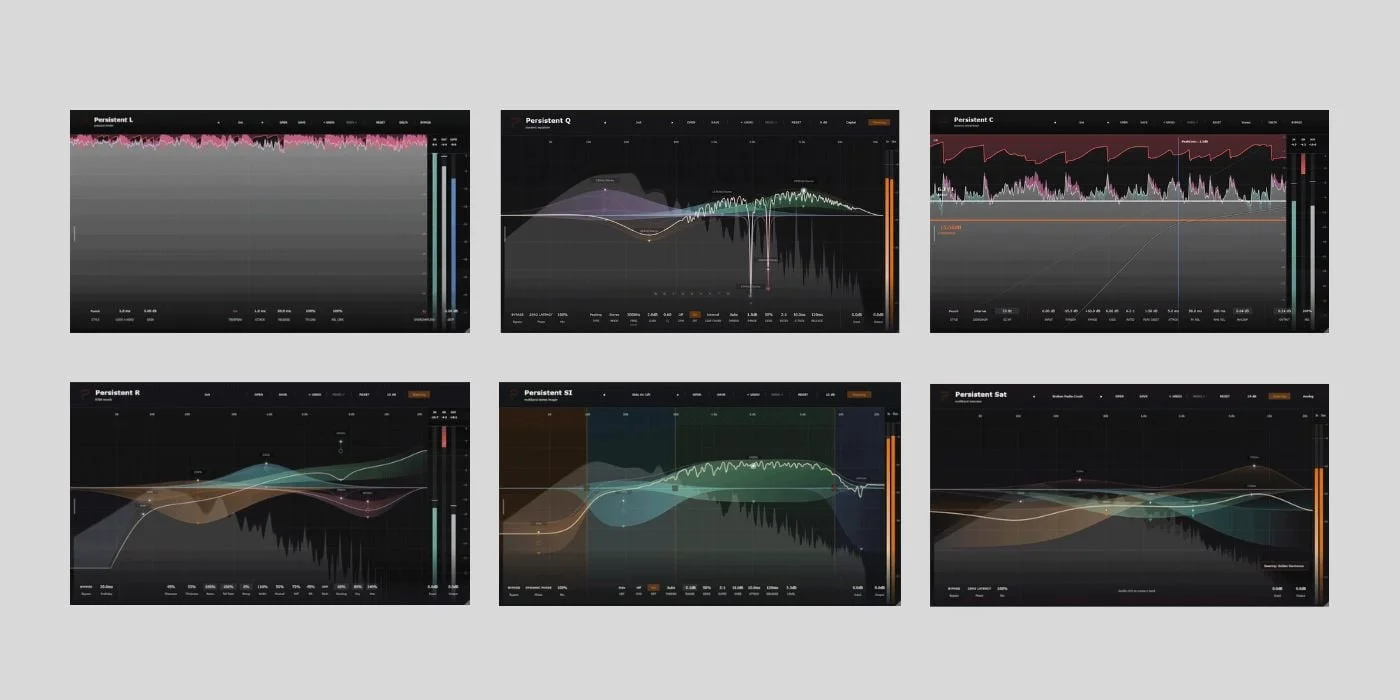
Persistent Series
Key Features
- Seven-plugin beta bundle covering EQ, compression, reverb, saturation, stereo imaging, loudness limiting, and modular audio routing.
- Persistent Q combines curve-drawing EQ workflow with dynamic EQ and spectral processing that can respond to incoming audio.
- Persistent C supports internal and external sidechain detection plus secondary attack and release controls for layered compression movement.
- Persistent R includes separate Post EQ and Tail EQ stages for shaping both the final reverb tone and decay behavior.
- Persistent Saturator applies frequency-targeted drive with peaking and shelf bands for more controlled harmonic enhancement.
- Persistent SI uses multiband stereo imaging to treat low, mid, and high-frequency width independently.
- Persistent Nodes provides an open node graph with audio effects, control logic, scripting, Faust nodes, and annotation tools.
Description
Persistent Series is a beta collection of seven VST3 effects from Kage Production for Windows-based production and mixing. The bundle covers precision EQ, compression, reverb, saturation, stereo imaging, loudness control, and a node-based modular effect environment.
The standard processors are aimed at practical mix and master-bus work rather than novelty sound design. Persistent Q handles corrective and tonal EQ, Persistent C covers track-to-master compression, Persistent R adds spatial depth, Persistent Saturator targets controlled harmonic drive, Persistent SI shapes stereo width, and Persistent L manages peaks and loudness.
Persistent Nodes is the experimental part of the series. Instead of a fixed chain, it lets users build custom audio and control graphs with gain, filter, distortion, delay, reverb, dynamics, mixer, math, logic, script, and Faust-based nodes.
The main caution is compatibility. Kage says the series aims to support Windows and macOS, but the currently verifiable technical listing and third-party launch coverage point to Windows VST3 builds, with macOS support unclear during beta.
Frequently Asked Questions
Which plugins are included in Persistent Series?
The bundle includes Persistent Q, Persistent C, Persistent R, Persistent Saturator, Persistent SI, Persistent L, and Persistent Nodes. Together they cover EQ, compression, reverb, saturation, stereo imaging, limiting, and node-based effect design.
Why is macOS not listed as a supported platform here?
Kage says the series aims to support both Windows and macOS, but also tells users to check each plugin's download page for supported operating systems. The clearest verifiable compatibility evidence found during this run was Windows VST3, and BPB reported that macOS testing was unsuccessful.
What makes Persistent Nodes different from the other plugins?
Persistent Nodes is closer to a modular effects construction environment than a fixed processor. It lets users connect audio and control nodes, build serial or parallel chains, use script and Faust nodes, and document complex patches with annotations.
Can the plugins be used in commercial productions?
Yes. Kage's official FAQ says Persistent Series plugins can be used for personal and commercial music production, while advising users to check detailed license terms on each plugin distribution page or license document.


