
LatticeReverb
Key Features
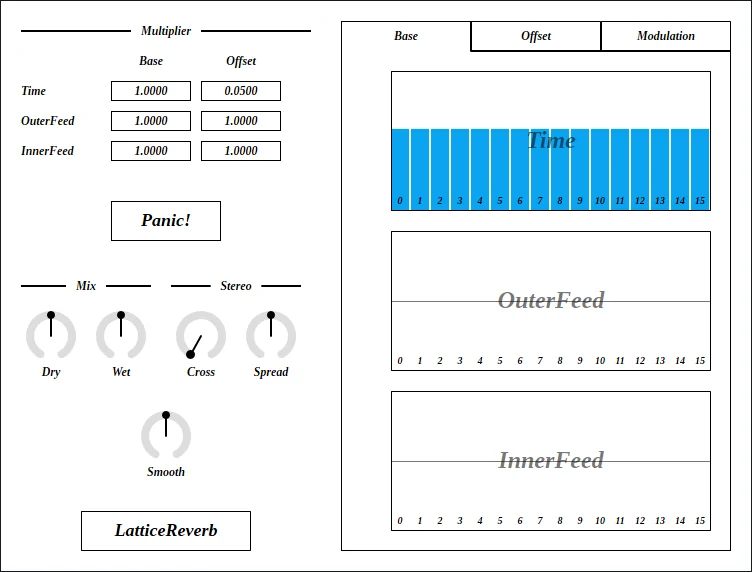
- Builds stereo reverb from a lattice structure of nested all-pass delays instead of a fixed set of room algorithms.
- Uses 16 delays per channel for a dense, configurable feedback network.
- Provides an LFO and low-pass filter for every internal delay, allowing modulation and tonal shaping inside the reverb engine.
- Exposes internal delay parameters for fine-grained DAW automation and experimental texture design.
- Uses Base and Offset controls to create related but different left and right channel settings for stereo spread.
- Includes M/S stereo spread control plus a Panic control for stopping output while testing more extreme feedback settings.
- Ships as a VST3 build for 64-bit Windows and Linux plus Universal 2 macOS.
Description
LatticeReverb is a stereo VST3 reverb from Uhhyou Plugins built around a lattice of nested all-pass delays. It exposes the internal delay network rather than hiding it behind a short list of room presets, so it can move from diffuse ambience toward metallic, delay-like textures when you push the structure into more extreme territory.
Each channel uses 16 delays, with a low-pass filter and LFO for every delay, and the plug-in exposes its internal parameters for detailed automation. Base and Offset controls let you introduce left/right differences, while M/S spread and modulation make it practical to turn a static tail into a wider, less predictable stereo effect.
That depth makes LatticeReverb especially useful for sound design, experimental transitions, and producers who want to shape the reverb engine itself rather than choose a conventional room type. It is less of a quick, transparent mixing reverb: the developer warns that changing certain feedback settings while audio is running can produce a loud output, so monitor levels and use the Panic control when exploring aggressive settings.
Frequently Asked Questions
What makes LatticeReverb different from a typical room reverb?
LatticeReverb uses a lattice of nested all-pass delays, with 16 delays per channel, rather than a small collection of named room models. Its individual delay controls are exposed, so the effect can be shaped as a sound-design processor as well as a reverb.
Can LatticeReverb create metallic or delay-like sounds?
Yes. The developer describes the Base setting as the control that determines the reverb character, while the delay network, filtering, and modulation can lead to more metallic or delay-like results. This makes it suited to deliberately artificial spaces as well as ambience.
Why should I watch levels when changing settings?
The official manual warns that output may become loud when OuterFeed or InnerFeed settings are near their limits and then changed while audio is passing through. Use normal gain staging and the plug-in's Panic control when testing aggressive feedback or modulation settings.
Does the Linux build work on every distribution?
No. Uhhyou states that the Linux build is made on Ubuntu 24.04 and may not run on other distributions. The manual also lists libxcb-cursor0 and libxkbcommon-x11-0 as required Ubuntu 24.04 packages.


