
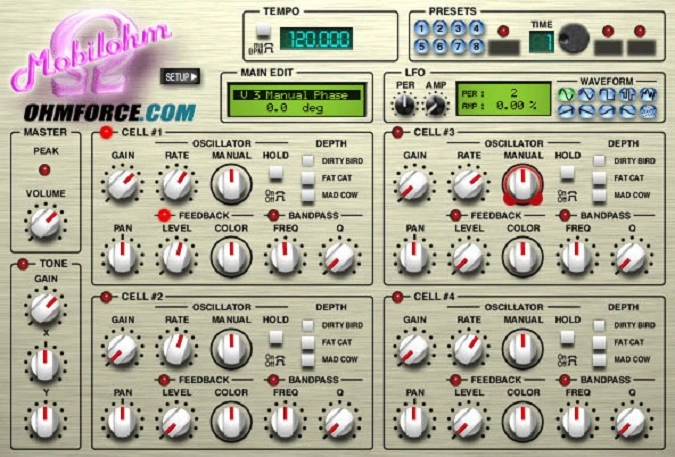
Legacy Mobilohm
Key Features
- Four independent phaser circuits, each splittable into four frequency bands with individual bandpass filters and three phasing algorithms
- Dedicated LFO for every parameter with ten waveform shapes, enabling complex tempo-synced rhythmic modulation across 50+ independent LFOs
- Envelope follower and xADSR module per parameter, all triggerable by MIDI velocity and pitch for performance-responsive phasing
- Three distinct phaser modes ranging from subtle vintage sweeps to deep, aggressive multi-stage effects
- Preset morphing for smooth real-time transitions between completely different phaser configurations during playback
- Two interface skins included: classic rack-style layout for precision editing and funky skin for a more visual workflow
- Full tempo sync on all time-related controls with the ability to modulate up to three parameters simultaneously per circuit
Description
Mobilohm by Ohmforce is a multi-phaser plugin built around four independent phaser circuits, each splittable into four frequency bands for separate processing. It goes far beyond a typical single-stage phaser, offering three distinct phasing algorithms per circuit alongside bandpass filters and individual volume controls.
Every parameter in Mobilohm has a dedicated LFO with ten waveform shapes, plus an envelope follower and xADSR module. All time-related controls can be tempo-synced, and modulation sources respond to MIDI velocity and pitch for expressive, performance-driven effects.
The plugin handles everything from gentle vintage sweeps to aggressive, swirling walls of modulated sound. Its preset morphing feature allows smooth transitions between entirely different configurations during playback, opening up possibilities that most phasers simply cannot touch.
Originally a commercial product praised by Computer Music magazine as "a very powerful multi-phaser," Mobilohm became part of Ohmforce's legacy collection in 2023. It ships with two interface skins: a classic rack-style layout for straightforward editing, and a "funky" skin that reflects Ohmforce's signature visual style.
Mobilohm is available as VST, AU, and AAX on macOS (Intel and Apple Silicon) and Windows. The sheer depth of its modulation routing makes it a genuine sound design instrument rather than a simple effect.
Video Preview

Tips
- Experiment with the different phaser modes to find the one that best suits your track.
- Use the LFOs to create rhythmic modulation effects that sync with your project's tempo.
- Take advantage of the envelope follower to add dynamic movement to your sounds.
- Utilize the preset morphing feature to smoothly switch between different phaser settings during a track.
- Split the phaser circuits into different frequency bands to achieve more complex and layered phasing effects.
- Explore the two interface skins to find the one that best fits your workflow and aesthetic preferences.
Frequently Asked Questions
What makes Mobilohm different from a standard phaser plugin?
Mobilohm runs four independent phaser circuits simultaneously, each with its own frequency band splitting, phasing algorithm selection, and a full set of modulation sources. Most phasers offer a single circuit with basic LFO control, while Mobilohm provides over 50 independent LFOs plus envelope followers and xADSR modules across all parameters.
Can Mobilohm sync its modulation to the DAW tempo?
Yes, all time-related controls in Mobilohm can be synced to your project's tempo. This makes it straightforward to create gated rhythms, tempo-locked sweeps, and pulsing phaser effects that stay perfectly in time with your track.
How does preset morphing work in Mobilohm?
Preset morphing lets you smoothly interpolate between two different Mobilohm configurations in real time. Rather than jumping between presets, the plugin gradually transitions every parameter from one setting to another, which is useful for creating evolving textures during a performance or arrangement.
Does Mobilohm use a lot of CPU resources?
With four phaser circuits and extensive modulation routing, Mobilohm can be more CPU-intensive than simpler phaser plugins. Running multiple instances simultaneously may require a reasonably powerful system, though a single instance on modern hardware should not cause issues.


