
Legacy QuadFrohmage
Key Features
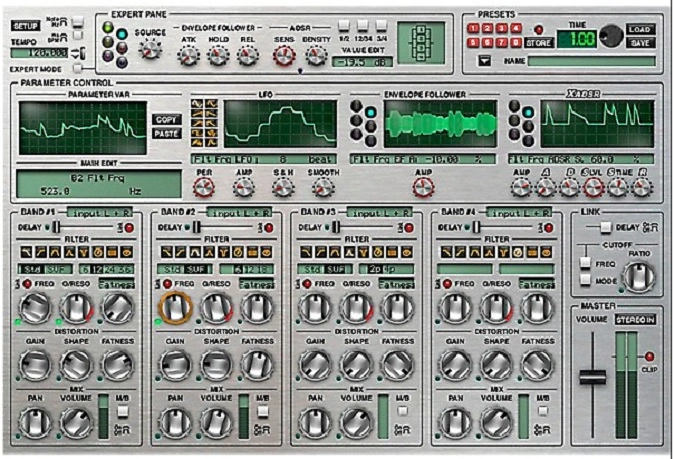
- Four independent filter units with 30 modes each, including comb, ring modulator, and Moog-style resonant filters
- Fully configurable signal routing between filters in serial, parallel, or hybrid topologies
- Deep per-parameter modulation via 10-type LFO, envelope follower, and xADSR with extra sustain stage
- BPM-synced timing for all LFOs, envelopes, and delay parameters to lock effects to your project tempo
- MIDI autobind for instant hardware controller mapping plus velocity and pitch-driven modulation
- Melohman preset morphing system for smooth real-time transitions between up to 12 stored settings
- Dual GUI skins with live-performance features including flying knobs and grouped parameter control
Description
Legacy QuadFrohmage by Ohm Force is a four-band filter effect plugin built for aggressive, creative sound sculpting. Originally a commercial product endorsed by artists like Trent Reznor and Stuart Price, it was released as a free legacy plugin when Ohm Force shifted focus to new developments.
Each of the four independent filter units offers 30 modes spanning classic low-pass, high-pass, band-pass, peak, and notch types alongside exotic comb filters, ring modulators, and a Moog-style resonant filter. The four bands can be routed in serial, parallel, or hybrid configurations, opening up layered filtering combinations that few single plugins can match.
Modulation depth is where QuadFrohmage truly separates itself from simpler filter effects. Every parameter can be driven by a dedicated 10-type LFO with sample-and-hold, an envelope follower with attack/hold/release controls, or an xADSR module with an extra sustain-time stage and sensitivity setting.
All time-related parameters lock to your DAW's BPM, and MIDI autobind lets you map any control to a hardware controller in seconds. The Melohman preset system enables smooth morphing between up to 12 stored settings during live performance.
Users consistently describe the sonic character as dirty and aggressive, capable of transforming soft, mellow signals into screaming, distorted textures. CPU usage is negligible, though the legacy version lacks modern Apple Silicon support and runs only on macOS 10.15 Catalina for Intel Macs or macOS 12+ for Apple CPUs.
Video Preview


Tips
- Experiment with different filter setups to find unique sound textures.
- Use the modulation features to create dynamic and evolving sounds.
- Sync the LFOs and other time-related parameters to your project’s BPM for rhythmic effects.
- Apply the envelope follower to parameters like cutoff frequency for responsive modulation based on the input signal.
- Use the preset morphing feature to smoothly switch between different sound settings during live performances.
- Take advantage of the MIDI autobind feature for quick and easy parameter control with your MIDI keyboard.
Frequently Asked Questions
Is Legacy QuadFrohmage still supported by Ohm Force?
No. Ohm Force released QuadFrohmage as a free legacy plugin and no longer provides technical support or updates. The plugin still works in current DAWs that support its format requirements, but no future bug fixes or compatibility patches are planned.
What is the difference between Frohmage and QuadFrohmage?
Frohmage is a single-band filter plugin, while QuadFrohmage provides four independent filter units that can be routed in serial, parallel, or hybrid configurations. QuadFrohmage also adds the Melohman preset morphing system and more advanced modulation routing across all four bands.
Can I use QuadFrohmage for rhythmic filter effects?
Yes. All time-related parameters including LFOs and envelope stages can sync to your DAW's BPM. Combined with four independently modulatable filter bands, this makes it well-suited for creating complex rhythmic filtering patterns and tempo-locked sequences.
How do the 30 filter modes differ from each other?
The modes range from standard low-pass, high-pass, band-pass, peak, and notch filters through to more exotic types like comb filters, ring modulators, and a Moog-style resonant filter that emulates the classic analog ladder circuit. Each mode has a distinct tonal character that can be further shaped by the resonance, fatness, colour, and damping controls.


