
Lisp
Key Features
- Level-independent sibilance detection that works regardless of input volume, eliminating the need to set a threshold
- Phase-cancellation-based reduction that removes sibilance transparently without introducing processing artifacts
- Automatic and manual processing modes for hands-off detection or targeted frequency control
- Adjustable sibilant range selector with Q control to target specific frequency bands from broad noise to sharp sibilants
- Zero-latency processing with minimal CPU usage suitable for real-time tracking and mixing
- Mid/side and per-channel stereo processing options for precise spatial control over sibilance reduction
- Sensitivity control that fine-tunes detection accuracy based on the characteristics of the vocal performance
Description
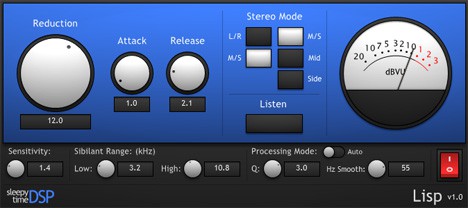
Lisp by Sleepy-Time DSP is a level-independent sibilance processor that takes a fundamentally different approach to de-essing. Instead of relying on traditional threshold and frequency controls, it uses an automatic detection algorithm that tracks both amplitude and pitch in real time to identify sibilant sounds like "ss", "teh", and "ch".
The plugin is internally tuned to the human vocal range and works regardless of input level. When sibilance is detected, Lisp generates an inverted copy of the signal to reduce its loudness through phase cancellation, delivering transparent results without the artifacts common in conventional de-essers.
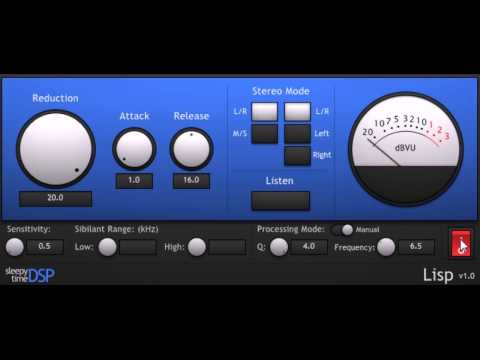
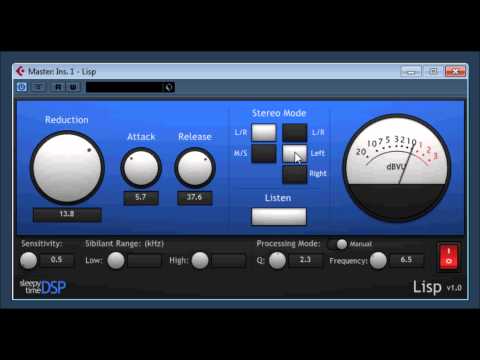
Controls include reduction amount (0-20 dB), attack and release for timing the gain reduction, sensitivity for adjusting detection threshold, and a sibilant range selector for targeting specific frequency bands in kilohertz. A Q knob narrows or widens the bandpass filter, while Hz Smooth prevents abrupt processing transitions.
Processing mode can be set to automatic or manual, with manual mode letting you target a specific frequency rather than relying on detection. Stereo processing options include mid/side mode and per-channel operation.
Gearspace users praise Lisp as one of the most practical de-essers available, noting its transparent sound quality and set-and-forget workflow. The plugin runs with zero latency and minimal CPU usage, making it suitable for both mixing and live tracking sessions.
Video Preview
Frequently Asked Questions
How does Lisp differ from traditional de-esser plugins?
Most de-essers require you to set a threshold and a target frequency, then compress when the signal crosses that threshold. Lisp instead uses a transient detection algorithm combined with pitch tracking to automatically identify sibilant sounds regardless of input level. This means it works consistently whether the vocal is whisper-quiet or full volume.
What is the best frequency range to set for de-essing with Lisp?
Sibilance typically falls between 4 kHz and 10 kHz depending on the vocalist. Use the sibilant range control to match the singer's voice: higher-pitched voices tend to produce sibilance closer to 8-10 kHz, while lower-pitched voices sit around 4-6 kHz. In auto mode, Lisp handles this detection for you.
Can Lisp process stereo audio or only mono vocals?
Lisp supports full stereo processing with multiple modes. You can process the left and right channels together, work in mid/side mode for treating center-panned vocals differently from side content, or process individual stereo channels independently.
Does Lisp introduce any latency to the signal chain?
No, Lisp operates with zero latency. This makes it suitable for use during live recording sessions where monitoring delay would be problematic, as well as in standard mixing workflows where you want to keep your plugin chain tight.


