

MDV-II
Key Features
- Instruction-level DASP-16 chip emulation running all 128 instructions per sample at the original 23,437.5 Hz internal sample rate
- All 100 factory programs across seven categories: reverb, gate, reverse, flange, chorus, delay, and EFX
- Dual-engine architecture chaining two DASP-16 chips in series for stacking any two programs together
- Vintage Mode drops processing to the original 31,250 Hz sample rate for authentic bandwidth-limited character
- Split-stereo mode for independent left and right channel processing with pan-spread stereo width controls
- MIDI CC Learn with right-click assignment, shared CC grouping, and mappings that persist across sessions
- No email gate or registration required for download on macOS and Windows
Description
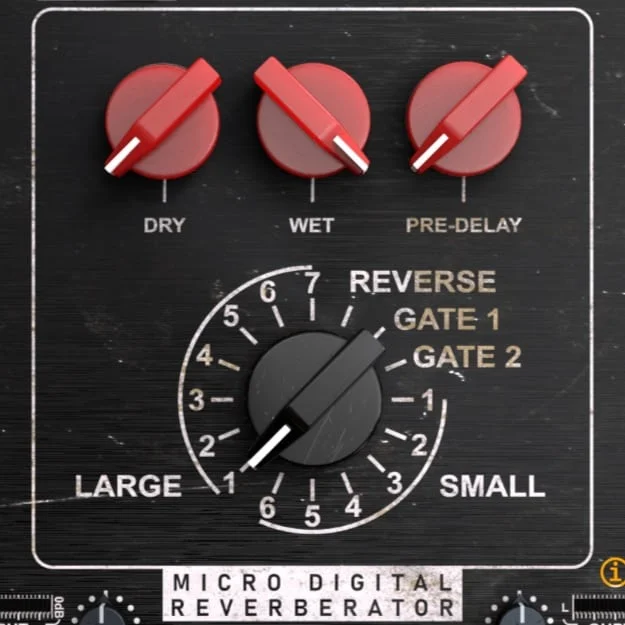
MDV-II by Temecula DSP is a faithful emulation of the Alesis MidiVerb II, the 16-bit digital multi-effects processor that became a cult favorite in shoegaze and alternative production after its release in 1987. The plugin recreates the custom DASP-16 chip at the instruction level, running all 128 instructions per sample at the original 23,437.5 Hz internal sample rate.
All 100 factory programs are included, organized into seven categories: reverb, gate, reverse, flange, chorus, delay, and EFX. My Bloody Valentine famously used the original unit's reverse reverb programs, and Primal Scream leaned on it for psychedelic textures.
What sets MDV-II apart from a simple recreation is its dual-engine architecture, which chains two mathematically modeled DASP-16 chips in series. Unit A feeds directly into Unit B, letting you stack a reverse reverb into a chorus, run a gated verb into a delay, or combine any two of the 100 programs for sounds the original hardware could never produce.
A Vintage Mode toggle drops the internal processing from the native sample rate down to the original hardware's 31,250 Hz, lowering the Nyquist ceiling to approximately 15.6 kHz and stretching reverb tails and delay times to match the original unit's character. Clean Mode applies a 4th-order Butterworth filter at 11,000 Hz for a brighter, more transparent sound.
The plugin also features a split-stereo mode for independent left/right channel processing, pan-spread controls for stereo width, MIDI CC Learn for hardware controller mapping, and a 125% GUI scaling option. No email or registration is required to download.
Video Preview

Frequently Asked Questions
How does MDV-II's dual-engine mode work?
MDV-II runs two mathematically modeled DASP-16 chips in series. Unit A feeds directly into Unit B, so you can stack any two of the 100 factory programs together. For example, you could chain a reverse reverb into a chorus, or run a gated verb into a delay for textures the original hardware could never produce on its own.
What does Vintage Mode do compared to Clean Mode?
Vintage Mode drops the internal processing to the original hardware's 31,250 Hz sample rate, lowering the Nyquist ceiling to approximately 15.6 kHz and stretching reverb tails and delay times for authentic MidiVerb II character. Clean Mode instead applies a 4th-order Butterworth filter at 11,000 Hz for a brighter, more transparent output.
Is there another free MidiVerb emulation available?
Yes, ArtV released TurboAlexis in March 2026, which is an open-source MidiVerb/MidiFex emulation. Audiority also released NeonVerb MV2, a paid convolution-based MidiVerb II reverb at $49. MDV-II distinguishes itself with instruction-level DASP-16 chip modeling and the dual-engine stacking feature.
Can I map MDV-II's controls to a MIDI controller?
Yes, version 0.4.4 added full MIDI CC Learn functionality. Right-click any knob to assign it to a physical controller, and multiple knobs can share the same CC for grouped control. All MIDI mappings persist when you save presets.


