
Moss Equalizer
Key Features
- A 265-band FFT engine gives unusually fine control over the frequency response curve.
- The 10 Hz to 20 kHz operating range supports low-end cleanup through high-frequency shaping.
- A -150 dB to +60 dB gain range accommodates deep notches and extreme experimental curves.
- Comb-filter modeling turns drawn EQ responses into vocal-like and resonant sound-design effects.
- Included comb-filter settings cover all 12 pitch classes with major, minor, pentatonic, and related scale options.
- A plotted curve workflow supports broad tonal moves, narrow cleanup, and complex repeated peaks from one interface.
- VST2 and VST3 builds are supplied for both 32-bit and 64-bit Windows hosts.
Description
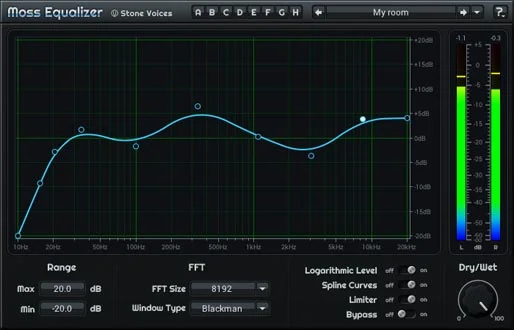
Moss Equalizer is a 265-band FFT equalizer from Stone Voices for unusually detailed frequency shaping, corrective cuts, and deliberately musical comb-filter curves. It works across 10 Hz to 20 kHz, with an exceptionally broad stated gain range of -150 dB to +60 dB for extreme filtering as well as conventional tone adjustment.
Rather than presenting fixed bands like a graphic EQ, Moss uses a plotted response curve that can be drawn into deep notches, broad boosts, and complex repeated peaks. That makes it useful for removing rumble and mains-related 50/60 Hz interference, but also for experimenting with resonant shapes that are more creative than a typical mix EQ.
Stone Voices includes comb-filter setting files for all 12 pitch classes, with major, minor, pentatonic, and other scale-oriented options. Those presets turn the equalizer into a sound-design processor capable of vocal-like or vocoder-adjacent coloration when used more aggressively.
The current developer page still provides the 1.4 release as a compact 3.1 MB public download, and positions it as a straightforward Windows plugin rather than a trial or time-limited offer. Its high-latency FFT approach makes it better suited to deliberate processing, sound design, and non-live mixing tasks than latency-sensitive monitoring chains.
Video Preview

Frequently Asked Questions
What makes Moss Equalizer different from a conventional graphic EQ?
Moss Equalizer uses a 265-band FFT response and a curve-based editing approach rather than a small set of fixed controls. This makes it capable of very detailed corrective shapes as well as repeated comb-filter patterns.
Can Moss Equalizer be used for creative effects?
Yes. Stone Voices specifically highlights comb-filter modeling, and includes settings based on all 12 pitch classes and several scale types. Aggressive curves can create resonant, vocal-like coloration instead of conventional tonal balancing.
Which plugin formats does Moss Equalizer provide?
The current Stone Voices page lists VST2 and VST3 versions in both 32-bit and 64-bit builds. Its stated requirements identify Windows 8, 8.1, or 10 and a DAW with VST support.
Is Moss Equalizer suitable for latency-sensitive live use?
It is based on FFT processing, and user feedback on the discovery listing reports high latency. Treat it as a deliberate mixing or sound-design tool and test it in the intended DAW session before putting it on a live monitoring path.


