
OCS
Key Features
- Four analog-modeled saturation algorithms (A, B, C, D) with distinct harmonic characteristics for console warmth through gritty drive
- Independent Input and Output level controls for precise gain staging before and after the saturation stage
- Console saturation mode for subtle channel coloring that adds analog-style weight to individual tracks
- Aggressive distortion capabilities when pushed harder, suitable for creative sound design and lo-fi textures
- Lightweight 3.8 MB footprint with minimal CPU usage for stacking across multiple channels
- Custom DSP building blocks developed beyond standard FlowStone templates for higher audio quality
Description
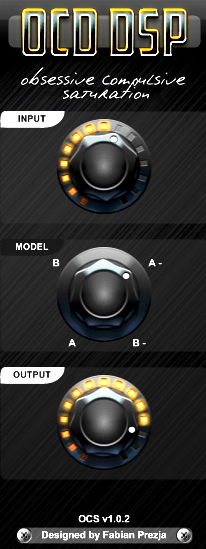
OCS (Obsessive Compulsive Saturation) by OCD DSP is a console saturation plugin that emulates the harmonic warmth of analog hardware. Built by developer Fabian Prezja using FlowStone with custom DSP building blocks, it delivers four distinct saturation models that range from subtle console coloring to more aggressive harmonic distortion.
The plugin offers a straightforward layout with Input and Output level controls and a Model selector knob that switches between four saturation algorithms labeled A through D. Each model imparts a different harmonic character, letting you choose between gentler tape-like warmth and edgier transistor-style drive depending on the source material.
Users consistently praise OCS for punching well above its weight in terms of sound quality, with some comparing its results favorably to paid saturation plugins. The simple interface means there is virtually no learning curve, making it easy to drop on individual channels as a console-style coloring tool or push harder for more noticeable distortion effects.
OCS was released in September 2013 and runs as a 32-bit VST plugin on Windows only, owing to its FlowStone-based architecture. The download is a compact 3.8 MB 7Zip archive containing a single VST DLL file.
Frequently Asked Questions
Does OCS work in 64-bit DAWs?
OCS is a 32-bit VST plugin only. To use it in a 64-bit DAW, you will need a 32-to-64-bit bridge like jBridge or the built-in bridging that some DAWs provide. Performance may vary depending on your bridging solution.
What are the four saturation models in OCS?
OCS includes models labeled A through D, each producing a different harmonic profile. Model A and B offer subtler console-style coloring, while C and D push into more aggressive territory with stronger harmonic distortion and drive character.
Is OCS still being developed or updated?
OCD DSP ceased development in early 2014 when the developer moved on to other DSP projects. The plugin remains available at version 1.0.2 and still functions on modern Windows systems, though no future updates are expected.


