
Phlegetron

Key Features
- Dual-band distortion engine lets you process two independently split bands instead of forcing one distortion curve across the full signal
- Cross mode behaves like a conventional crossover, making it easy to keep lows cleaner while driving the upper band harder
- Harm mode separates audio into harmonic bins around the selected frequency for more reactive, source-dependent distortion behavior
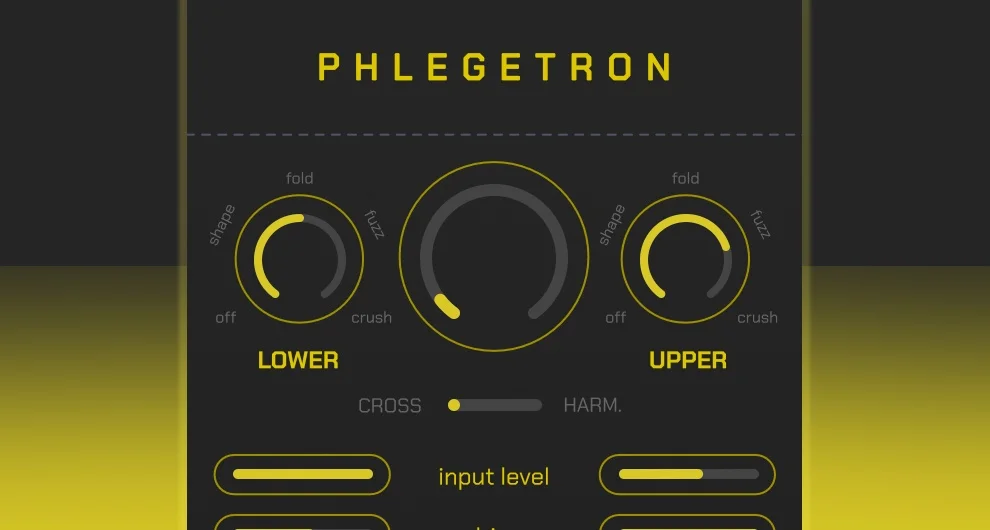
- Five per-band modes cover bypass, waveshaping, wavefolding, hard-clipped fuzz, and crushed digital distortion with quantization artifacts
- Shared Input Level, Drive, and mode-sensitive Modifier controls keep the interface fast while still changing the character of each algorithm in meaningful ways
- Link and Dry/Wet controls support mirrored dual-band setups and parallel distortion blends without extra routing, and every parameter is automatable
Description
Phlegetron is a dual-band distortion plugin from Igorski that splits incoming audio into two independently processed bands instead of smearing the same drive across the whole signal. The official design centers on two split modes: a familiar crossover for low-versus-high shaping, and a harmonic-bin mode that isolates overtones around a chosen frequency for much stranger, source-dependent results.
Each band has its own mode selector and can be set to Off, Shape, Fold, Fuzz, or Crush, so the plugin can move from mild harmonic seasoning to clipped, sputtering, broken-sounding textures. Input Level, Drive, and a context-sensitive Modifier control the behavior of each distortion type, while Link mirrors one side to the other and Dry/Wet makes parallel blending straightforward.
That combination makes Phlegetron less about polite sweetening and more about selectively wrecking only the part of a sound you want to push. It is especially well suited to synths and other harmonically rich material, where the harmonic split and wavefolding options can create reactive upper-band aggression without flattening the whole source into one block of fuzz.
The plugin is still presented on Igorski's official site as a direct-download release rather than a trial, promo, or email-gated freebie, so it qualifies as a permanent freeware tool. Current binaries cover Windows 10+ in VST3 format plus macOS Catalina+ on Intel and Apple Silicon with both VST3 and Audio Unit builds, and the GPL source repo remains available for anyone who wants to compile it for Linux.
Frequently Asked Questions
What is the difference between Cross and Harm mode in Phlegetron?
Cross mode splits the signal with a standard crossover so you can treat low and high frequencies differently. Harm mode instead isolates harmonic overtones around the selected frequency into one band and leaves the rest in the other, which makes the distortion react much more to the source material.
Can I keep one side clean while distorting the other band?
Yes. Each band has its own mode selector, and one of the five options is Off, so you can leave one band untouched while the other uses Shape, Fold, Fuzz, or Crush. That is one of the easiest ways to preserve low-end weight while pushing the upper spectrum harder.
What does the Modifier slider do?
Modifier changes function depending on the selected distortion mode. On the official page, Igorski notes that it controls curve shape in Shape mode, fold threshold in Fold mode, gating behavior in Fuzz, and bit reduction depth in Crush.
Is Phlegetron better for subtle tone or experimental destruction?
It can do both, but the strongest case is creative sound design rather than gentle mix polishing. The official page and launch coverage both point to harmonically rich sources and happy-accident experimentation as the sweet spot, especially when the harmonic split and more aggressive modes are pushed together.
Does Phlegetron support Linux?
There are no official Linux binaries in the current release archives. Igorski links directly to the GPL source repository instead, so Linux users need to build it themselves from source.


