
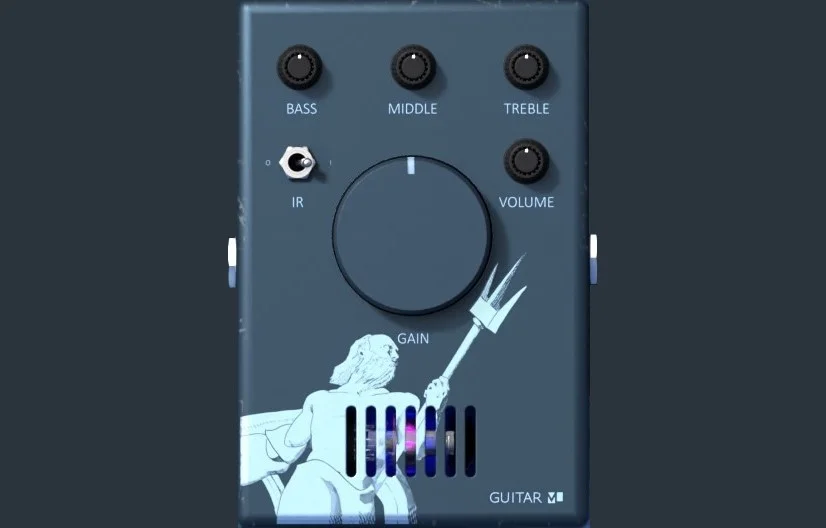
Proteus
Key Features
- Loads neural models of guitar amplifiers, preamps, and drive or boost pedals.
- Supports captures made from mic'd rigs or direct load-box outputs.
- Uses a dedicated Capture Utility and Google Colab workflow for building compatible models.
- Accommodates Snapshot models for a single setting and Knob models for a control range.
- Version 1.2 adds three-band Bass, Mid, and Treble tone shaping.
- Includes a default impulse response for a convenient starting cabinet sound.
- Works with GuitarML's Tone Library of compatible amp and pedal captures.
Description
Proteus is GuitarML's neural-network guitar amp and pedal capture plug-in. It loads compatible models of amplifiers, preamps, distortion, overdrive, and boost pedals, letting you place a captured tone directly in a DAW rather than committing to one fixed virtual amp.
You can make a model from a mic'd amp or a direct load-box output. Mic'd captures include the recorded cab and speaker character, while direct-out models need a separate impulse-response plug-in to recreate the cabinet side of the rig.
For creating captures, GuitarML supplies a Capture Utility with a WAV stimulus file and Google Colab workflow. The process supports quick Snapshot models for a single device setting as well as Knob models intended to represent the range of a control such as gain, drive, or EQ.
Version 1.2 adds Bass, Mid, and Treble controls plus a default IR, giving loaded models basic tone shaping and an immediate starting point. GuitarML also maintains a Tone Library of compatible models, so the plug-in suits players who want to audition community captures as well as build models from their own gear.
Proteus is available as a 64-bit Windows plug-in, a macOS plug-in, and a Linux plug-in. The developer lists VST3 and AAX for Windows and Linux, with AU, VST3, and AAX on macOS; select the appropriate installer from the official release page.
Frequently Asked Questions
What can Proteus capture?
GuitarML describes Proteus as a tool for emulating guitar amplifiers, preamps, and distortion, overdrive, or boost pedals. A compatible model can be made from a microphone recording of a rig or from a direct load-box output.
Do direct-out amp captures need an impulse response?
Yes. GuitarML says a direct-out model needs an impulse-response plug-in to accurately model the amp speaker and cabinet. A mic'd capture instead records that cab and speaker character as part of the capture.
What is the difference between Snapshot and Knob models?
Snapshot models represent a device at one setting and are the quicker capture route. Knob models are intended to cover the range of a control such as gain, drive, or EQ, and the developer's capture instructions call for multiple output WAV files for that workflow.
Can I use models other players have made?
Yes. GuitarML maintains a Tone Library with compatible models, and Proteus can load a folder containing Proteus JSON model files. Models made for NeuralPi and SmartPedal use a different architecture and are not compatible.


