Pulsar Vintage
Key Features
- Particle synthesis engine based on Curtis Roads' pulsar theory, generating sound from rapid trains of micro-waveforms called pulsarets
- Independent fundamental and formant frequency controls for shaping pitch, rhythm, and spectral content separately
- Produces a wide range of textures from percussive pops and crackles to sustained resonant drones and complex harmonic tones
- Low-latency performance optimized for live use and real-time parameter manipulation
- Highly responsive to external DAW modulation and automation for evolving sound design
- Lightweight CPU footprint suitable for layering multiple instances in a session
Description
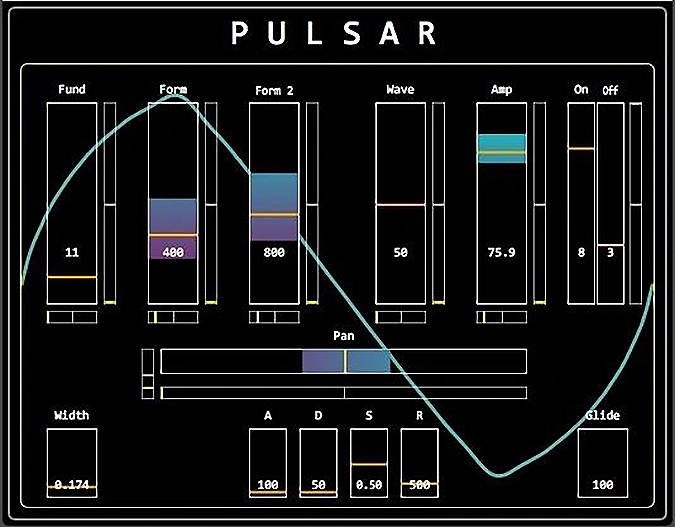
Pulsar Vintage by Recluse Audio is a particle synthesis instrument built on the research of Curtis Roads and Karlheinz Stockhausen. It generates sound by firing rapid trains of sonic particles called pulsarets, short waveform bursts followed by silence gaps, which produce tones, rhythms, and evolving textures depending on how fast they repeat.
The plugin gives you independent control over fundamental frequency and formant frequency. The fundamental sets the overall repetition rate of the pulsar train, while the formant shapes the spectral content of each individual pulsaret, letting you morph between percussive clicks, resonant drones, and complex harmonic timbres.
Pulsar Vintage is the original version of the Pulsar engine, completed during Ryan Devens' graduate studies at Georgia Southern University in 2020. Its interface is more compact than the newer Pulsar 2.0, but the core synthesis engine delivers the same spectral precision and responds particularly well to external modulation from your DAW.
The plugin was originally sold for $40 before Recluse Audio made their entire catalog permanently free in 2023. It supports VST3 and AU formats on both Windows and macOS, making it compatible with most modern DAWs including Ableton Live, Logic Pro, and Pro Tools.
Video Preview

Frequently Asked Questions
What is pulsar synthesis and how does Pulsar Vintage use it?
Pulsar synthesis generates sound by repeating short waveform bursts (pulsarets) separated by silence. The speed of repetition sets the fundamental pitch, while the pulsaret's duration controls the formant frequency. Pulsar Vintage implements this technique with independent controls for both parameters, letting you create sounds that range from percussive clicks at low rates to pitched tones and resonant textures at audio rates.
What is the difference between Pulsar Vintage and Pulsar 2.0?
Pulsar Vintage is the original version with a more compact interface and fewer modulation options built in. Pulsar 2.0 expands on the engine with additional controls, a redesigned GUI, and more internal modulation routing. Both share the same core particle synthesis engine and are available for free from Recluse Audio.
Can Pulsar Vintage be modulated from a DAW?
Yes, Pulsar Vintage responds well to external modulation via DAW automation. Mapping LFOs, envelopes, or MIDI controllers to its parameters turns static pulsar trains into evolving textural performances. This is one of its key strengths noted by users who pair it with Ableton Live's modulation tools.