
qb (Kyubi)
Key Features
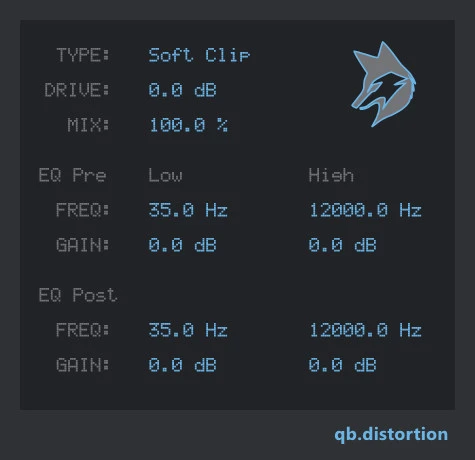
- Nine distortion modes covering soft clip, hard clip, linear fold, sine fold, rectification, asymmetric waveshaping, tube-screamer-style drive, and bit crushing.
- Pre-distortion and post-distortion EQ sections for shaping what hits the drive stage and taming the processed tone afterward.
- Low shelf controls before and after distortion with a 35 Hz to 400 Hz frequency range.
- High shelf controls before and after distortion with a 1100 Hz to 12 kHz frequency range.
- Drive gain range from -30 dB to +30 dB for moving between subtle saturation and aggressive overload.
- Wet/dry mix from 0% to 100% for parallel distortion without extra DAW routing.
Description
qb (Kyubi) is a Windows distortion effect from Sender Spike built around nine clipping, folding, rectifier, waveshaping, and bit-crushing modes. It puts that distortion stage between pre and post EQ sections, so the same plugin can push selected frequencies into the drive circuit and then reshape the result afterward.
The control set is intentionally direct. Drive runs from heavy attenuation to strong gain, wet/dry mix covers full parallel blending, and each EQ side gives you low and high shelves for broad tone shaping before and after the distortion.
That layout makes Kyubi useful for producers who want a small character processor rather than a deep multiband effects workstation. It can handle basic soft clipping, harder digital destruction, folded harmonics, rectified tones, tube-screamer-style asymmetry, and bit-crushed edge without loading separate plugins for each flavor.
The trade-off is platform and polish.
Frequently Asked Questions
What distortion modes does Kyubi include?
The official Sender Spike page lists soft clip, hard clip, linear fold, sine fold, full rectifier, half rectifier, asymmetric tube screamer, another asymmetric waveshaper, and bit crushing. Each mode shares the same drive and wet/dry controls.
Why are there EQ controls before and after the distortion?
The pre EQ changes which frequencies hit the distortion harder, while the post EQ shapes the already-distorted signal. That makes it easier to push lows, highs, or mids into the effect and then clean up harshness afterward.
Is Kyubi a deep distortion workstation?
No. The appeal is its compact one-page design and quick access to multiple distortion flavors. Producers who need detailed modulation, multiband routing, oversampling choices, or preset-heavy workflows may prefer a larger paid distortion plugin.


