Resonarium
Key Features
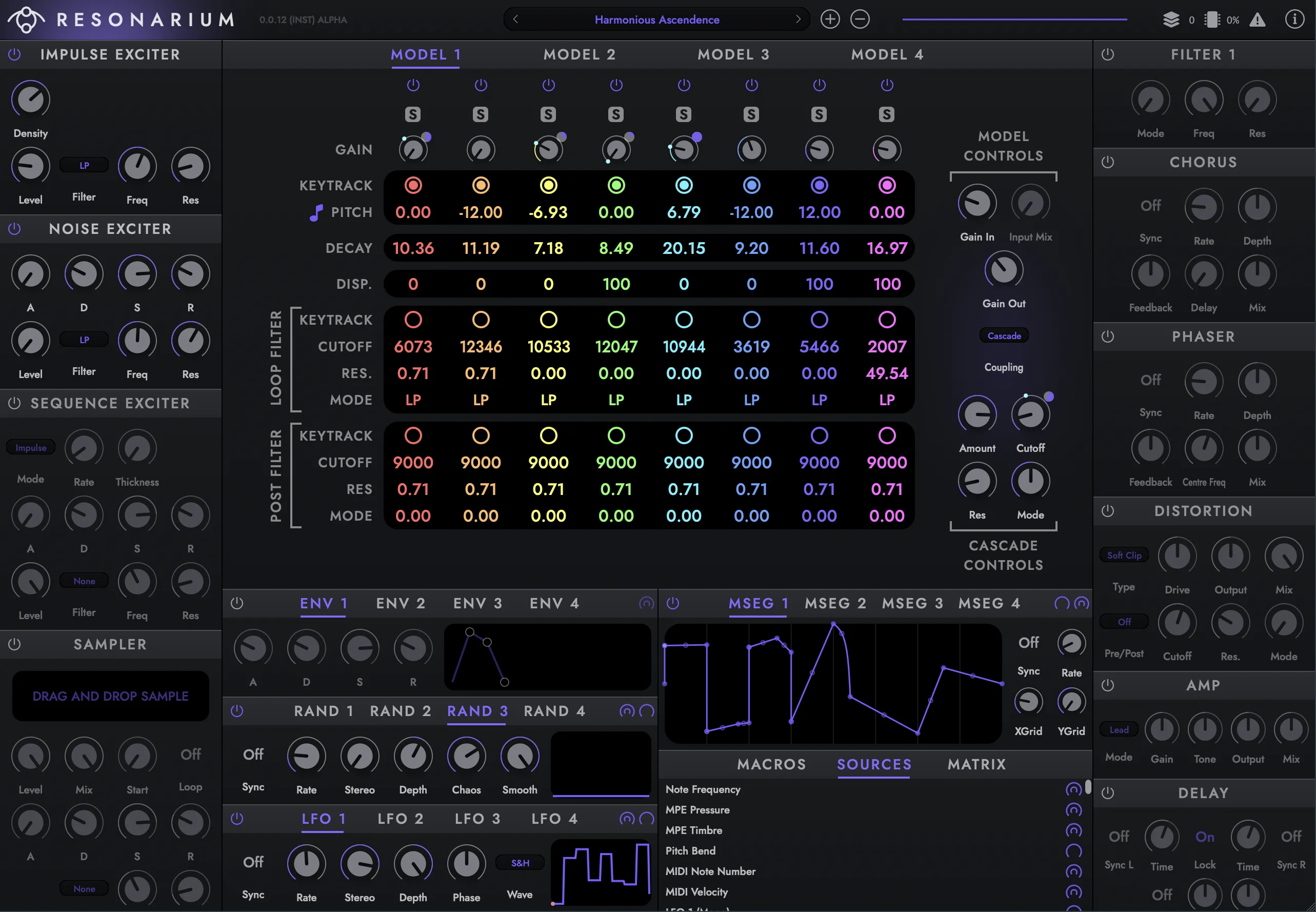
- Coupled string waveguide engine designed for physical-modeling tones, resonant objects, and abstract acoustic textures.
- MPE-aware preset design makes pressure and timbre controls useful with expressive controllers.
- Multiple model sections provide deep resonator behavior for plucked, struck, metallic, and evolving sounds.
- Exciter options include impulse, noise, sequencing, sampling, and external audio workflows for flexible sound generation.
- Modulation system combines ADSR envelopes, MSEGs, LFOs, random sources, macros, MIDI CC, and MPE sources.
- Built-in effects include filtering, chorus, phaser, distortion, amp processing, and delay for shaping patches inside the instrument.
- Ships as instrument and effect builds, with VST3, AU on macOS, and standalone versions included in the release archives.
Description
Resonarium is an experimental physical-modeling synthesizer from Soule DSP built around coupled string waveguide models. It is aimed at abstract sound design, expressive performance, and open-ended exploration rather than conventional subtractive synth programming.
The synth is especially interesting with MPE controllers such as Ableton Push 3 or Roli Seaboard, because many presets respond to pressure and timbre dimensions. Its sound palette leans toward plucked strings, metallic resonances, shimmering struck tones, unstable textures, and evolving acoustic-like objects that can move well beyond realistic instrument emulation.
Under the hood, Resonarium combines four model sections, multiple exciters, a sampler, envelopes, MSEGs, LFOs, random sources, macros, MIDI control, and onboard effects. The current release also ships both instrument and effect builds, so it can be played as a synth or used to process external audio inside compatible hosts.
This is still early-stage software, with the developer focusing on stability and performance. Expect higher CPU usage on complex polyphonic presets, possible DAW-specific issues, and the need to keep monitoring levels conservative because waveguide models can behave unpredictably.
Frequently Asked Questions
Is Resonarium stable enough for finished projects?
Resonarium is still in development, and the developer says the current focus is stability and performance. It can be useful for sound design and experimentation, but users should expect bugs, crashes, higher CPU use, and DAW-specific behavior in serious sessions.
Does Resonarium require an MPE controller?
No. Resonarium can be played without MPE hardware, but many presets are designed to become more expressive with pressure and timbre data from controllers such as Ableton Push 3 or Roli Seaboard.
Can Resonarium process external audio?
Yes. The release includes instrument and effect builds, and the README explains that the effect version can use live external audio input or sit inside an effect chain in a DAW.
What should users know before monitoring Resonarium loudly?
The developer warns that waveguide modeling can be unpredictable and recommends setting safe maximum output levels before use. Resonarium includes overflow protection, but unstable patches can still create sharp pops or sudden silence.