
Retro Radio
Key Features
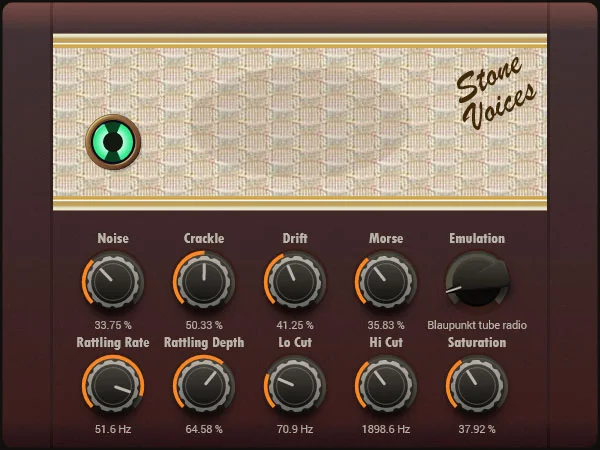
- AM-radio modeling combines band-limited speaker tone with static, crackle, rattles, parasitic modulation, and Morse-like interference instead of stopping at a basic lo-fi EQ curve
- Radio-size voicing can move between larger stationary receivers and smaller pocket-radio acoustics, which helps the effect feel like a specific playback device rather than generic degradation
- Separate interference layers let you keep the core speaker coloration and blend in only the amount of noise, drift, or broadcast damage the source actually needs
- Amplitude-frequency distortion adds the squeezed midrange, unstable breakup, and worn transmission character associated with aging broadcast hardware
- Vintage tube-radio styling with a 6E5C-inspired magic-eye level meter keeps the interface readable while matching the plug-in's period-correct concept
- Works especially well on vocals, drum breaks, synths, ambience beds, and transition FX when you need believable transmission wear or harsher degraded textures
Description
Retro Radio is a vintage broadcast simulator that goes beyond a simple band-pass filter, turning clean audio into something closer to a worn AM receiver with static, crackle, rattles, parasitic modulation, and bursts of Morse-like interference. It is built for sound-design inserts, vocal treatments, and scene-setting transitions where you want the full personality of old tabletop and pocket radios rather than generic lo-fi dulling.
The core appeal is that the imperfections are layered instead of baked into one fixed preset. Stone Voices pairs amplitude-frequency distortion with separate radio-style interference behaviors and lets you shift the acoustic footprint between larger stationary sets and smaller portable radios, so the effect can move from lightly aged speech to fully damaged transmission tone.
That makes it more useful than a one-trick nostalgia filter. In the KVR launch thread, users described it as a fun, CPU-efficient creative freebie for texture work, while the developer noted the interference layers default to zero, so you can start with just the speaker voicing and add noise, crackle, drift, or Morse artifacts only as needed.
As checked on April 23, 2026, Retro Radio is still a direct-download freeware release on the official Stone Voices site, with version 1.0.1 available for Windows and macOS. The macOS package currently ships with AU and VST3 builds, and the official page plus developer forum posts position it as the current supported release rather than a limited-time promo.
Frequently Asked Questions
What makes Retro Radio different from a normal lo-fi filter?
It models the behavior and faults of old AM reception, not just a narrowed EQ curve. Alongside the speaker tone, it adds controllable noise, crackle, rattles, parasitic modulation, and Morse-like interference so the result feels more like an actual radio than a generic degraded insert.
Can Retro Radio do subtle processing, or is it only for destroyed effects?
It can stay fairly restrained. In the KVR discussion, the developer explained that the interference layers default to 0%, so you can start with the radio voicing alone and add only as much crackle, drift, or Morse contamination as the part needs.
Does Retro Radio support Apple Silicon?
Stone Voices confirmed on April 13, 2026 that the macOS release is available for both Intel x86_64 and Apple Silicon arm64 systems. In the macOS package I checked, the AU build is universal while the bundled VST3 binary appears arm64-only, so Intel users may want to start with the AU version.
Is the effect strictly mono like a real AM radio?
Not automatically. A KVR user pointed out that the current version does not include a dedicated mono-sum control, so if you want a fully collapsed broadcast image, sum the signal to mono before or after the plugin in your DAW.
Do you need an account or email signup to download it?
No account gate is advertised on the official product page.


