Sanford Reverb
Key Features
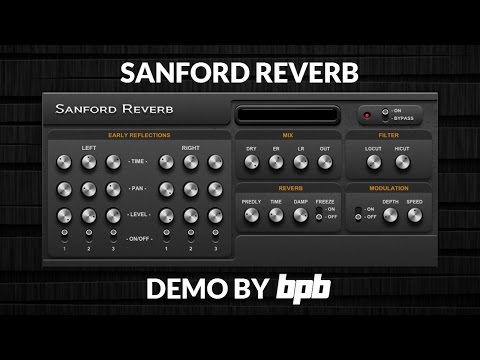
- True stereo reverb with six independently configurable early reflections (three per channel) featuring individual time, pan, and level controls
- Dense, clean algorithmic reverb engine with adjustable pre-delay, decay time, and damping to simulate a wide range of room characteristics
- Built-in filter section for shaping the tonal quality of the reverb output from dark and warm to bright and airy
- Modulation controls add natural movement to the reverb tail, creating more realistic and animated spatial effects
- Freeze mode sustains the reverb tail indefinitely for creative sound design, ambient textures, and build-up effects
- Full MIDI learn support for mapping any parameter to hardware controllers
- 20 expertly crafted presets ranging from small rooms and plates to large cathedrals and infinite reverbs
Description
Sanford Reverb by Leslie Sanford is a true stereo algorithmic reverb plugin that simulates everything from tight ambiences to massive cavernous spaces. Originally a paid plugin, it became freeware in 2015 with the release of version 2.1, which added 64-bit support.
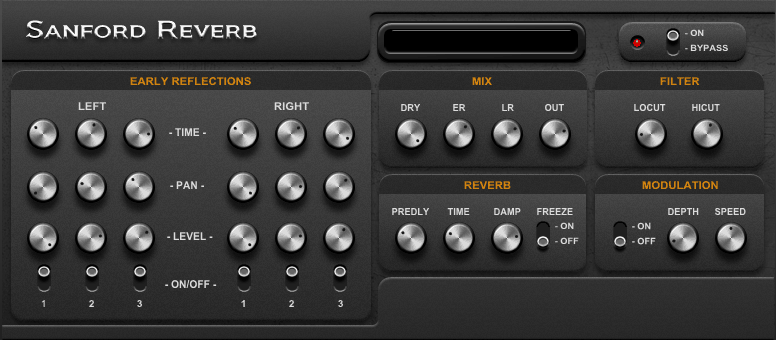
What sets it apart from most reverbs is its detailed early reflections section. Each stereo channel has three independently adjustable early reflection points with separate time, pan, and level controls, giving you precise shaping over how the initial sound bounces interact.
The reverb engine produces a dense, clean tail with global pre-delay, decay time, and damping controls that simulate wall absorption characteristics. A dedicated filter section shapes the output tone, while a modulation section adds movement to the reverb tail for a more lively, animated sound.
A freeze mode locks the reverb tail into an infinite sustain, which works particularly well for building lush vocal textures, ambient pads, or EDM-style risers. The plugin ships with 20 well-designed presets covering small rooms through large cathedrals and infinite spaces.
CPU usage remains remarkably low during operation, typically staying under 3% on a single core. The interface is clean and intuitive, organized into five logical sections: Early Reflections, Mix, Reverb, Filter, and Modulation.
Video Preview

Frequently Asked Questions
What makes Sanford Reverb's early reflections section different from other reverbs?
Sanford Reverb provides six individual early reflection points (three per stereo channel), each with independent time, pan, and level controls. This level of per-reflection control is uncommon in reverb plugins and allows you to shape exactly how the initial sound bounces behave in the virtual space.
How does the freeze mode work in Sanford Reverb?
The freeze mode captures and sustains the current reverb tail indefinitely, creating an infinite sustain effect. This is especially useful for building ambient textures, enhancing soloed instruments, creating lush vocal washes, or generating EDM-style build-up effects.
Is Sanford Reverb resource-intensive?
No, Sanford Reverb is exceptionally lightweight. During testing, the CPU usage typically stays under 3% per instance on a single-core processor. You can comfortably run multiple instances across a mix without noticeable performance impact.
Does Sanford Reverb support 64-bit DAWs?
Yes. Version 2.1 (released in November 2015) added native 64-bit support. The download includes both 32-bit and 64-bit DLL files, so it works in modern 64-bit host applications as well as legacy 32-bit setups.