
Soft Limit
Key Features
- Faithful emulation of Apogee's analog Soft Limit converter circuit from the AD-500 series
- Adjustable soft limit threshold with smooth transient rounding and tape-like harmonic saturation
- Drive control with plus or minus 18dB of level trim before the Soft Limit stage
- Oversampling up to 16x for artifact-free saturation with low CPU impact
- Auto Makeup gain that compensates output level as the threshold is lowered
- Dedicated input, soft limit, and output metering for precise visual feedback
Description
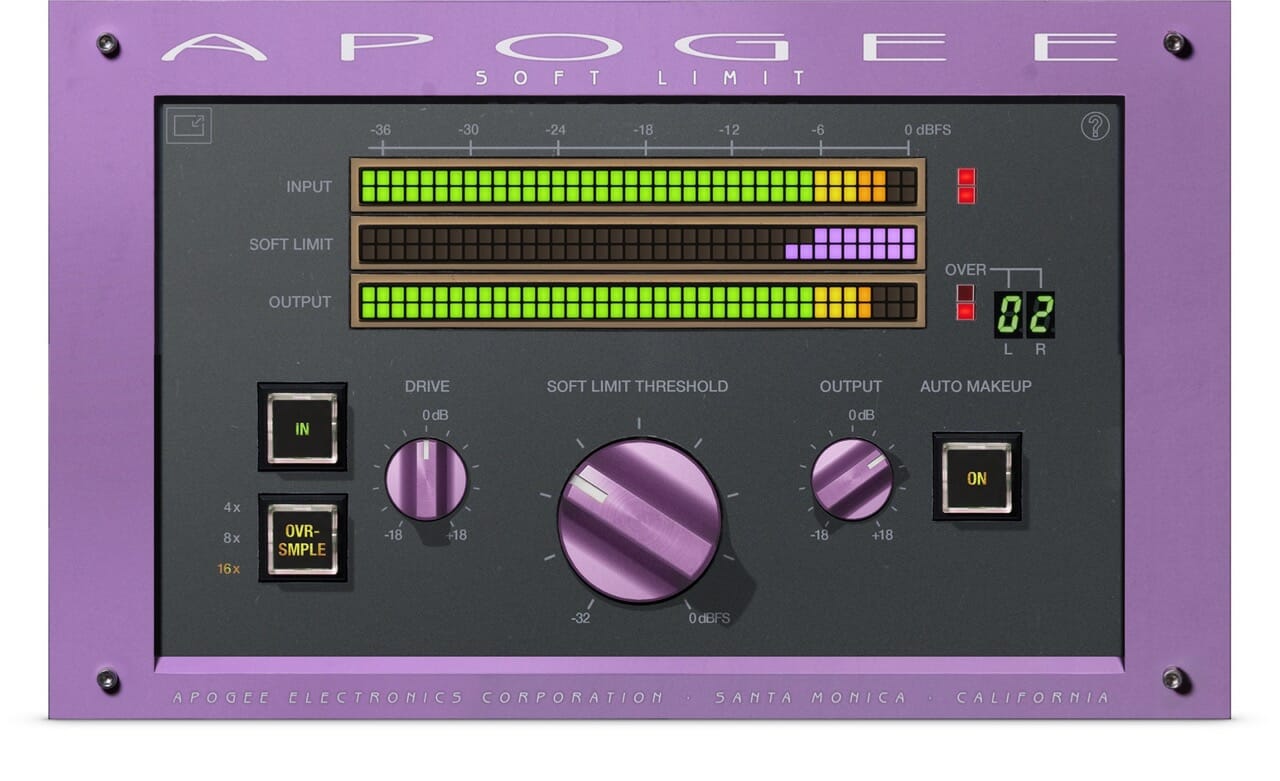
Soft Limit by Apogee is a plugin recreation of the analog Soft Limit circuit found in Apogee converters since the AD-500 in 1991. This circuit sits before the A-D conversion stage, gently rounding transients and adding tape-like harmonic warmth to the signal.
The plugin provides a Drive control with plus or minus 18dB of level trim feeding into the Soft Limit section, where an adjustable threshold determines how aggressively the signal is shaped. An Auto Makeup feature compensates for gain reduction as the threshold is lowered, keeping perceived loudness consistent.
Oversampling options at 4x, 8x, and 16x help reduce aliasing artifacts while maintaining low CPU usage and latency even at the highest setting. Three metering displays for input, soft limit activity, and output provide clear visual feedback of how the plugin affects the signal.
Users praise Soft Limit for its non-fizzy saturation character that adds punch and cohesiveness to drums and mix buses without sounding harsh. The effect works well when applied subtly across multiple channels, resulting in a warmer and more rounded mix overall.
The interface is straightforward with three main controls for Drive, Soft Limit threshold, and Output, plus a manual output adjustment of plus or minus 18dB. Apogee designed this as a faithful translation of the hardware circuit that has been used on countless platinum-selling records.
Video Preview


Frequently Asked Questions
What does Apogee Soft Limit actually do to the audio signal?
Soft Limit emulates an analog circuit originally placed before the A-D conversion stage in Apogee converters. It gently rounds transients and adds harmonic content similar to analog tape saturation, making the signal sound warmer and more cohesive without hard clipping.
How does Soft Limit compare to a traditional brickwall limiter?
Unlike brickwall limiters that prevent peaks from exceeding a ceiling, Soft Limit uses soft clipping to gradually round transients and add harmonic coloration. It is designed more for tonal shaping and warmth than for loudness maximization, though it does tame peaks in the process.
What oversampling setting should I use with Soft Limit?
Apogee designed Soft Limit to maintain low CPU usage even at 16x oversampling. Higher settings reduce aliasing artifacts for cleaner saturation, so 8x or 16x is recommended for final mixes and master buses. Lower settings work well for tracking and drafting where CPU headroom matters more.
Can Soft Limit be used on individual tracks or only on the master bus?
Soft Limit works on both individual tracks and buses. Many producers use it subtly across multiple channels to add cohesive warmth throughout a mix, while others apply it more aggressively on drum buses for punch and glue. The Drive and threshold controls make it flexible for either approach.


