
SoftAmp PSA
Key Features
- Five cascaded nonlinear distortion stages modeled after the SansAmp PSA-1 circuit, each with distinct frequency-shaping characteristics
- Built-in PSI Denoiser noise gate with automatic threshold learning that calibrates to your noise floor in a single click
- Squeezo Range compressor based on the Orange Squeezer, functioning as both upward and downward compressor before the preamp
- Asymmetric mode introduces even harmonics by replacing balanced zener diodes with an unbalanced 3.3V/4.7V pair
- Soft-Clip mode reduces op-amp open-loop gain for smoother saturation transitions and more natural sustain decay
- Integrated speaker simulator with Shape and Rolloff controls, fully bypassable for use with external IR loaders
- Real-time EQ frequency plot and per-stage clipping LED indicators for visual feedback on saturation levels
Description
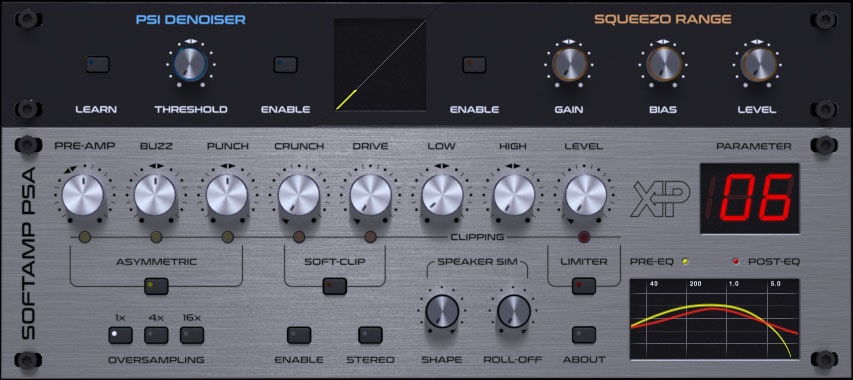
SoftAmp PSA is a virtual-analog guitar preamp plugin modeled after the legendary Tech 21 SansAmp PSA-1 rackmount unit. Developed by AXP for the 2016 KVR Developer Challenge, it packs a full signal chain into a single window: five nonlinear distortion stages, a tonestack, a built-in speaker simulator, and output level control.
The first three distortion stages use op-amps with zener diodes in the feedback chain, while the final two are op-amps driven into saturation. Each stage has a distinct frequency-shaping character, visible in the real-time EQ plot.
The PSI Denoiser noise gate, inspired by the ISP Decimator, features an automatic threshold-learning function that calibrates to your noise floor in one click. It sits at the front of the signal chain and can be used independently of the amp section.
The Squeezo Range compressor, based on the Orange Squeezer circuit, sits before the preamp and acts as both an upward and downward compressor depending on gain and bias settings.
Advanced controls include Asymmetric mode, which swaps the default 4.7V/4.7V zener pair for an unbalanced 3.3V/4.7V pair to introduce even harmonics, and Soft-Clip mode, which reduces the op-amp open-loop gain from one million to 200 for smoother saturation and more natural note decay. Speaker simulator Shape and Rolloff knobs can be zeroed out to bypass the cab section entirely for use with external impulse response loaders.
Users on Ultimate Metal and KVR forums praise the plugin for bass work, noting it delivers convincing clank tones without complex high-pass-before-drive routing. The REAPER Blog featured it in a mixing walkthrough as a go-to SansAmp-style processor for both guitars and parallel drum processing.
Video Preview


Frequently Asked Questions
What hardware is SoftAmp PSA modeled after?
SoftAmp PSA is modeled after three classic hardware units: the Tech 21 SansAmp PSA-1 rackmount preamp for the distortion and tonestack section, the ISP Decimator for the noise gate, and the Dan Armstrong Orange Squeezer for the compressor. The distortion stages use nonlinear filter modeling rather than a simpler cascaded filter/static waveshaper approach.
Can SoftAmp PSA be used for bass as well as guitar?
Yes. Users on Ultimate Metal and KVR forums specifically praise the plugin for bass, noting it produces convincing clank tones without needing a separate high-pass filter before the drive stage. The REAPER Blog also demonstrated it on kick and snare drums in parallel processing chains.
What do the Asymmetric and Soft-Clip buttons do?
Asymmetric mode replaces the default matched 4.7V/4.7V zener diode pair with an unbalanced 3.3V/4.7V pair, adding even harmonics that become more pronounced as you drive the first three stages harder. Soft-Clip reduces the op-amp open-loop gain from one million to 200, creating a gentler transition into saturation that smooths out harsh overtones and helps fading notes sustain more naturally.
How do I bypass the built-in speaker simulator?
Set both the Shape and Rolloff knobs to zero. This completely bypasses the speaker simulator section, letting you route the output into an external impulse response loader or cabinet simulator of your choice.


