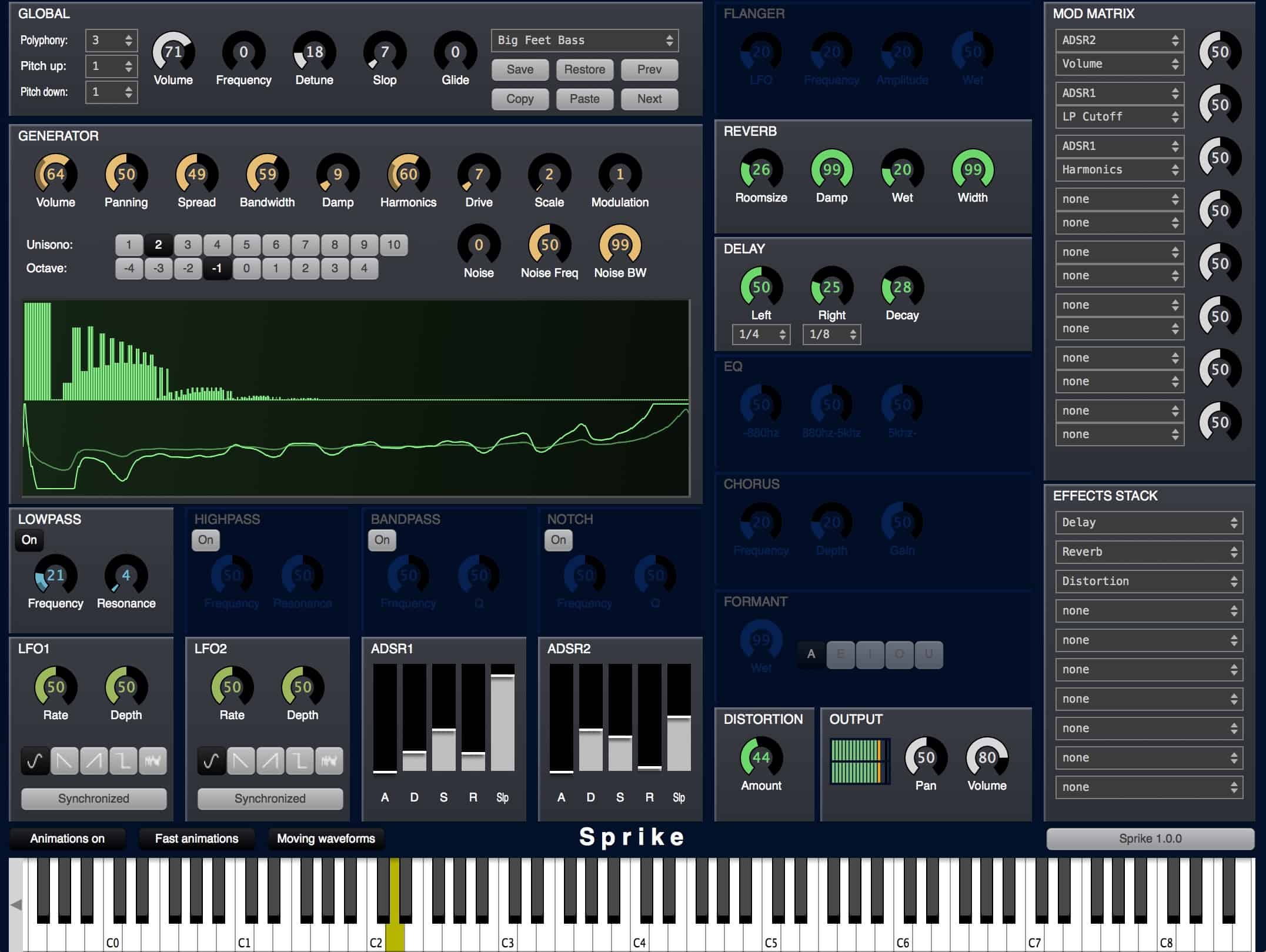
Sprike
Key Features
- Additive synthesis engine derived from Tunefish4, capable of producing crisp digital leads, warm pads, acoustic-style strings, and aggressive basses
- Four series-connected filters with a modulation matrix offering eight sources, 29 destinations, and eight depth controls for deep sound design
- Flexible effects stack supporting up to ten modules in series, including Flanger, Chorus, Reverb, Delay, EQ, Vowel Formant Filters, and Distortion
- Extremely lightweight CPU footprint allowing ten or more simultaneous instances without significant performance impact
- Full MIDI implementation with bank and program selection, master volume and pan controllers, and tempo-synced delay times
- Clipboard-based preset sharing between instances with automatic synchronization across open editors
- Open-source GPL-3.0 license with complete source code on GitHub for customization and learning
Description
Sprike is an additive synthesizer built on top of Tunefish4, the open-source virtual analog synth originally created by Brain Control for the demo scene. Cognitone extended it with a reorganized preset system, four additional modulation sources, an on-screen keyboard, master volume and pan controls, a level meter, and tempo-synced delay times.
The synthesis engine generates everything from crisp digital timbres to expressive acoustic-style tones including basses, bells, strings, and distorted guitars. Its four series-connected filters, modulation matrix with eight sources and 29 destinations, and a flexible effects stack of up to ten modules in series give deep sound-shaping control without a steep learning curve.
Sprike ships with seven built-in effects: Flanger, Chorus, Reverb, Delay, EQ, Vowel Formant Filters, and Distortion. Two LFOs and two ADSR envelope generators feed the modulation matrix, enabling complex evolving patches from a lightweight engine.
The plugin is exceptionally CPU-efficient, allowing ten or more instances in a single project with minimal performance impact. Version 1.9.2 added native Apple Silicon support, improved HiDPI scaling on Windows, and clipboard-based preset sharing between instances.
Sprike is released under the GPL-3.0 license with full source code available on GitHub, making it both a practical production tool and a learning resource for developers interested in audio plugin architecture.
Video Preview

Frequently Asked Questions
What synthesis method does Sprike use?
Sprike uses additive synthesis to generate its raw tones, combined with subtractive-style filtering through four series-connected filters. This hybrid approach produces a wide timbral range from clean digital sounds to warm analog-style tones without the CPU overhead of full wavetable or physical modeling engines.
How does Sprike relate to Tunefish4?
Sprike is an extended fork of Tunefish4 by Brain Control. The core synthesis engine is identical, so Tunefish4 presets are backward compatible. Cognitone added reorganized preset management, four extra modulation sources, an on-screen keyboard, and improved MIDI implementation while keeping the same lightweight audio engine.
Can I run multiple Sprike instances without CPU issues?
Yes. Sprike originated from demo-scene code optimized to run in under 10 KB of machine code, so its CPU footprint is exceptionally small. The developer confirms ten or more instances can run simultaneously in a project with minimal impact on system performance.
Does Sprike support Apple Silicon Macs natively?
Yes. Version 1.7.4 introduced native Apple Silicon (M1/M2) support, and the current version 1.9.2 continues to run natively on both Intel and Apple Silicon processors. The macOS installer is also notarized by Apple for security.