Telescope
Key Features
- Combines thirteen analysis lenses for loudness, dynamics, spectral, stereo, tonal-balance, and musical-key investigation in one plug-in.
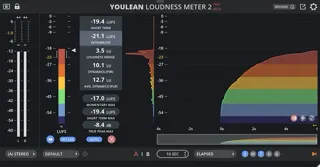
- Measures integrated, short-term, and momentary LUFS, loudness range, and true peak against documented broadcast-standard methods.
- Shows PSR, PLR, a short-term histogram, and clip-event history to make headroom and dynamic behaviour easier to inspect.
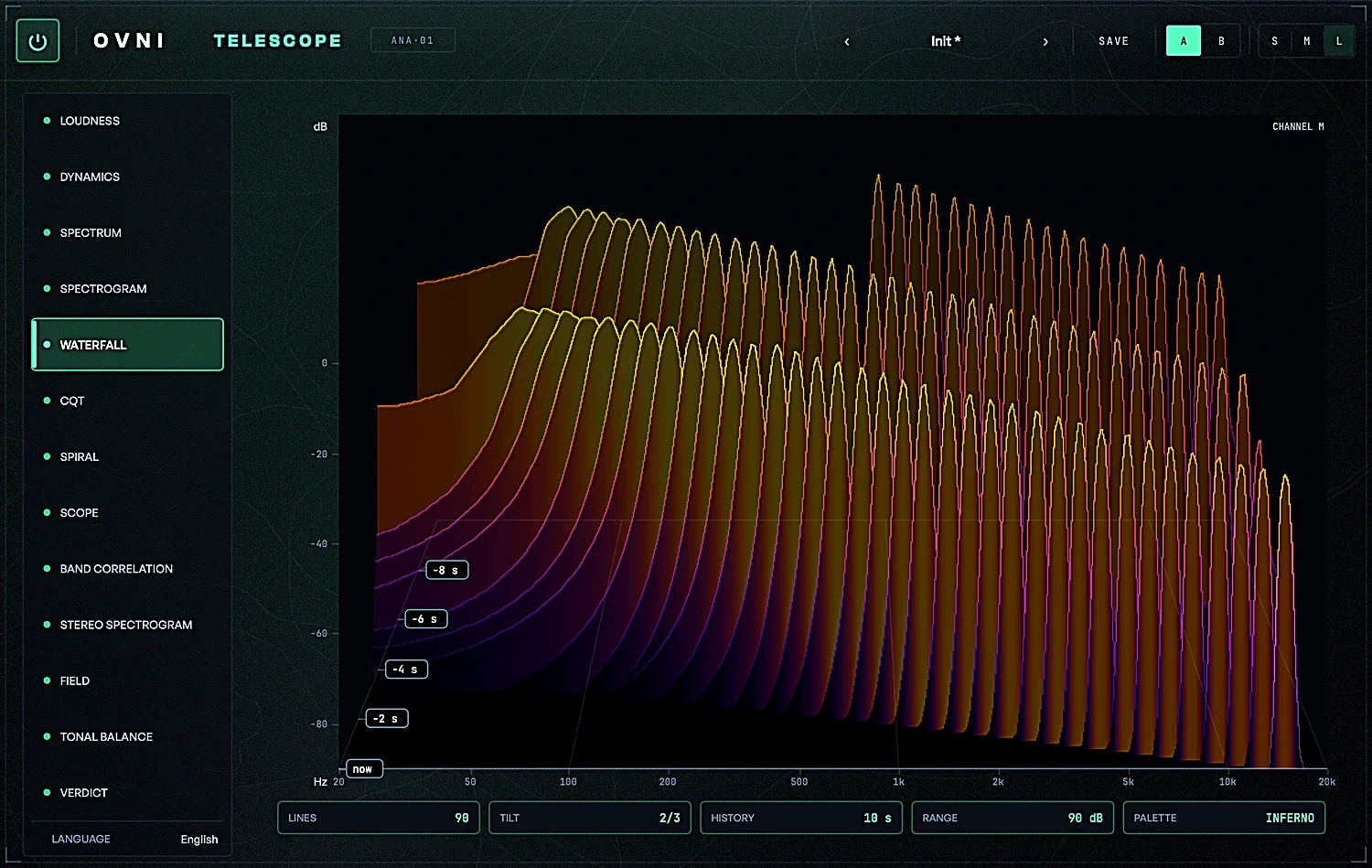
- Offers FFT, spectrogram, waterfall, constant-Q, and chromagram views for tracing frequency content and tonal activity over time.
- Includes scope, per-band correlation, and stereo-spectrogram tools for checking width, balance, phase behaviour, and mono loss.
- Compares tonal balance with a loaded reference track and reports deterministic Verdict findings with their measured value and rule ID.
- Passes audio through bit-exactly with zero samples of latency, while analysis runs separately from the audio path.
Description
Telescope is a stereo audio-analysis plug-in from OVNI Audio that combines loudness, dynamics, spectrum, stereo, tonal-balance, and key-oriented views in one interface. Its thirteenth view, Verdict, turns its measurements into rule-linked findings, while the plug-in remains a bit-exact pass-through with no added latency.
For mix and mastering checks, Telescope covers integrated, short-term, and momentary loudness, LRA, true peak, PSR and PLR, plus FFT, spectrogram, waterfall, and constant-Q views. Its stereo tools extend beyond a single correlation value with scope, band correlation, a stereo spectrogram, and pan-direction energy displays.
The Tonal Balance lens compares a mix against a user-loaded reference track after normalising each by integrated loudness. Verdict is deliberately a reporting layer rather than an automatic mix assistant: its 21 deterministic rules identify a measurement and the rule that produced the observation, leaving the decision to the engineer.
OVNI Audio supplies Telescope v0.1.0 as an email-gated VST3 download for Windows 10 or later and VST3/AU for macOS 11 or later. The macOS installer is signed and notarized; Windows is supplied as an unsigned ZIP, so the developer notes that SmartScreen may warn during installation.
Frequently Asked Questions
Does Telescope process or change the audio passing through it?
No. OVNI Audio describes Telescope as a bit-exact pass-through with zero samples of latency and no tail. The analysis runs separately, so it is designed to measure rather than process the signal.
What does Telescope's Verdict view do?
Verdict applies 21 deterministic rules to its per-second measurement history and writes observations alongside the number and rule that produced each one. It reports measurements rather than making automated mix changes or aesthetic judgments.
Can Telescope compare a mix with a reference track?
Yes. Its Tonal Balance lens compares the mix with a reference track that you load, normalising each track by its own integrated loudness before showing the balance difference. This is intended as a measurement view, not a substitute for listening.
Which stereo checks are available?
Telescope includes scope, correlation, width, balance, mono-loss, per-band correlation, and a stereo spectrogram. Its FIELD and POLAR LEVEL views show energy by pan direction; the developer specifically says they are not source-localisation tools.
How is Telescope downloaded?
Use the official Telescope page and select the macOS or Windows download route. OVNI Audio's catalog says the download starts after submitting an email address; the page handles the current installer and platform selection.