
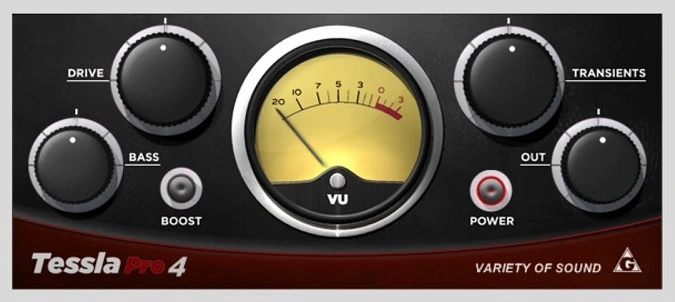
TesslaPRO mkIV
Key Features
- New transformer model with hysteresis effects for realistic magnetic-core saturation behavior
- Transient-aware processing that polishes peaks while preserving punch and dynamics
- Simplified gain staging for consistent performance across a wide range of input levels
- Automatic output volume compensation to maintain predictable loudness
- Stereo field enhancement that adds depth and dimension without phase artifacts
- Lightweight and efficient design with minimal CPU overhead
- Intuitive four-knob interface with VU metering for precise gain control
Description
TesslaPRO mkIV is a transformer-style signal saturator by Variety of Sound, built to reintroduce analog character into digital mixing and mastering workflows. It subtly colors audio, polishes transients, and adds depth and dimension to the stereo field.
The mkIV is the fourth iteration of the TesslaPRO line, which originally launched in 2009 as a successor to the TesslaSE. This version introduces a completely new transformer model with integrated hysteresis effects, capturing the nonlinear behavior of real magnetic cores for enhanced realism.
Gain staging has been simplified compared to previous versions, delivering consistent saturation across a broad range of input levels. Automatic output volume compensation keeps loudness predictable, so engineers can focus on tonal shaping rather than level management.
The plugin's four-knob interface and VU meter make it straightforward to dial in the right amount of coloration. A dedicated mode selector and boost control let you push the effect from transparent warming to more noticeable harmonic enhancement.
Gearspace users describe the mkIV as a "massive improvement" over the mkIII, calling it "one of the best subtle saturators" available regardless of price. The Tape setting in particular is praised for adding useful character without being heavy-handed.
The download is a single 36 MB ZIP file from the Variety of Sound website, with no email gate or registration required. The plugin requires the Visual C++ Redistributable for Visual Studio 2022.
Video Preview


Tips
- Use the plugin to add subtle analogue warmth to your digital mixes.
- Apply TesslaPRO mkIV on the master bus to achieve a cohesive and professional sound.
- Experiment with the gain staging to find the sweet spot for your input levels.
- Utilize the automatic output volume compensation to maintain consistent levels throughout your mix.
- Take advantage of the plugin's efficiency to use it in high-demand environments without impacting system performance.
Frequently Asked Questions
What is the difference between TesslaPRO mkIV and mkIII?
The mkIV features a completely new transformer model with integrated hysteresis effects, which captures nonlinear magnetic-core behavior for more realistic saturation. It also introduces simplified gain staging and automatic output volume compensation, both of which were absent in the mkIII. Gearspace users report the mkIV sounds significantly improved, with more refined and musical coloration.
What does TesslaPRO mkIV do to audio?
TesslaPRO mkIV is a transient-aware signal saturator that models transformer-coupled analog circuits. It adds subtle harmonic coloration, smooths transients, and enhances the stereo field to give digital mixes a cohesive analog character. The effect ranges from transparent warming to more noticeable tape-like saturation depending on the gain setting.
Does TesslaPRO mkIV have high CPU usage?
The mkIV was redesigned for more efficient operation compared to previous versions. However, some users report an initial load time of several seconds as the plugin scans system fonts on first insert. Once loaded, CPU usage is generally low and suitable for use across multiple tracks.
Can TesslaPRO mkIV be used on the master bus?
Yes, the plugin is specifically designed for both individual track processing and mix bus use. Its automatic output volume compensation and simplified gain staging make it well-suited for mastering chains where level consistency is critical. Many users stack multiple instances across a mix for a cohesive analog sound.


