TetraOP
Key Features
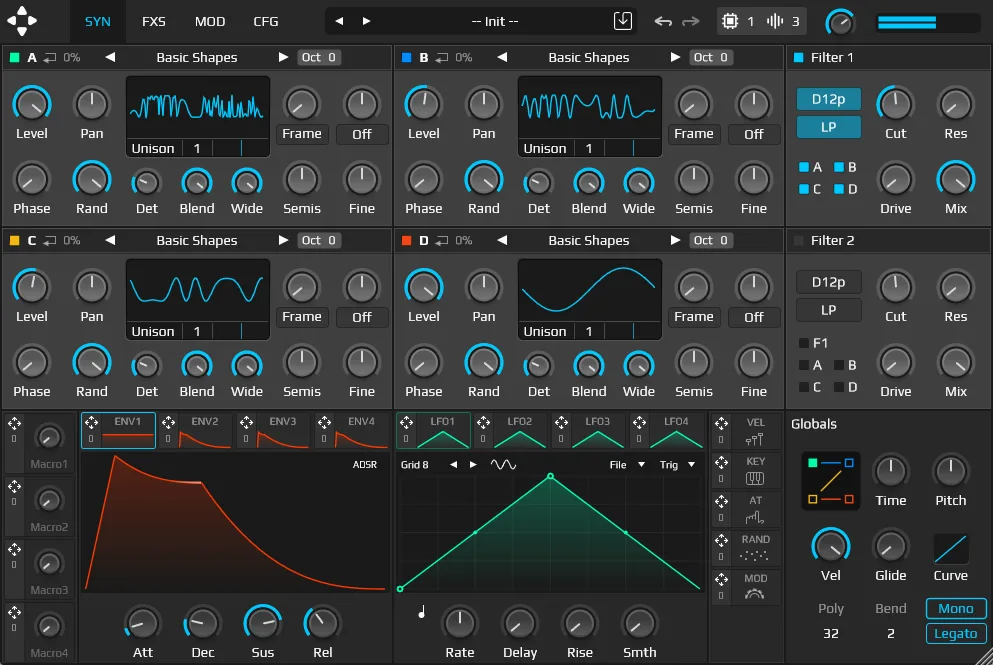
- Four-operator wavetable synth engine with FM and ring-modulation routing
- Ten predefined FM layouts plus an FM/RM routing matrix for custom operator relationships
- Sixteen unison voices per operator with five unison modes for wide digital stacks
- Eight phase-distortion modes for adding sharper movement before filtering
- Two filters with five filter types and four modes each for shaping bright or metallic patches
- Drag-and-drop modulation with envelopes, LFOs, macros, and other modulation sources
- Open-source GitHub release with current Windows, macOS, and Linux builds
Description
TetraOP by Tilr is an open-source wavetable and FM synthesizer built around four operators, phase modulation, ring modulation, unison, filters, and drag-and-drop modulation. It takes inspiration from Ableton Operator, but replaces the classic FM-only shape with four wavetable oscillators that can be routed through predefined layouts or a modulation matrix.
The synth is strongest for animated digital basses, metallic FM tones, wide unison leads, and hybrid wavetable patches where operator routing matters more than a large preset library. The developer is explicit about the tradeoffs: there is no wavetable editor, no deep preset browser, and the filter section is intentionally modest compared with larger commercial instruments.
That focus makes TetraOP more useful as a hands-on sound-design tool than a polished workstation synth. Sixteen unison voices per operator, five unison modes, eight phase-distortion modes, two multimode filters, envelopes, LFOs, macros, and other modulation sources give it enough movement for experimental electronic patches without hiding the core FM and wavetable structure.
The current GitHub release provides Windows, macOS, and Linux builds, with source code published under GPL-3.0. Rekkerd, KVR, and Synth Anatomy all describe it as a free KVR Developer Challenge 2026 release, and no paid tier, coupon gate, or expiry language was found on the official repository or release page.
Video Preview


Frequently Asked Questions
Is TetraOP closer to a wavetable synth or an FM synth?
It sits between both. Each of the four operators is wavetable-based, but the routing, FM layouts, phase modulation, and ring modulation make it behave more like an operator synth than a standard subtractive wavetable plugin.
Does TetraOP include a wavetable editor or preset browser?
The official README says it does not have a wavetable editor or a great preset browser. It is better treated as a compact sound-design synth than a preset-heavy workstation.
What formats are available?
Rekkerd lists VST3, AU, and LV2 formats for Windows, macOS, and Linux. The GitHub release currently provides separate ZIP builds for Windows, macOS, and Linux.
Is the source code available?
Yes. The official GitHub repository is public and the repository metadata lists GPL-3.0 as the license.