
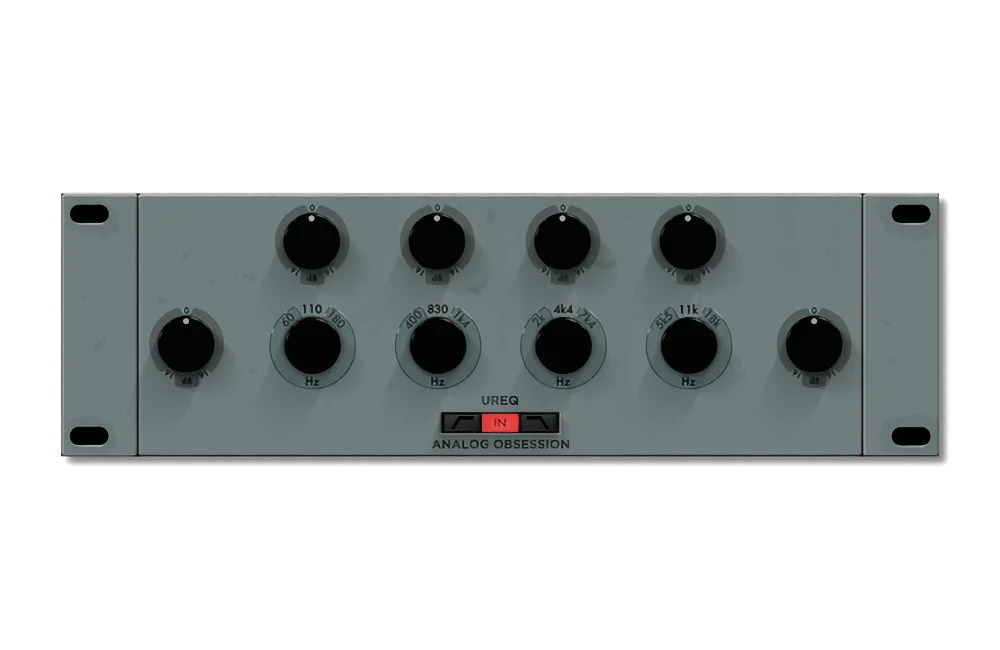
UREQ
Key Features
- 4-band analog-style EQ with three switchable fixed frequencies per band and up to 16 dB of cut and boost
- Gain-compensated input drive that produces warm, op-amp-like saturation from line amps and filter circuits
- Proportional Q behavior where bandwidth automatically adjusts based on gain amount and frequency selection
- Fixed 80 Hz high-pass and 12 kHz low-pass filters for quick spectral cleanup
- Deliberately stripped-down interface with no frequency analyzer, encouraging ear-based mixing decisions
- Resizable GUI with touchscreen support and Apple Silicon native compatibility
- Dual input and output controls with 16 dB of range and automatic gain compensation
Description
UREQ by Analog Obsession is a stripped-down 4-band analog-style equalizer designed for fast, musical tone shaping. Each band offers three switchable fixed frequencies with up to 16 dB of cut or boost, and the Q width changes automatically based on gain and frequency settings.
The real standout feature is the gain-compensated input stage, which doubles as a saturation circuit. Pushing the input drive introduces warm, op-amp-style harmonic coloration from the line amp and filter circuits, letting you add character without wrestling with gain staging.
Four bands cover the full spectrum: lows at 60/110/180 Hz, low-mids at 400/830/1.4 kHz, high-mids at 2/4.4/7.4 kHz, and highs at 5/11/18 kHz. Fixed 80 Hz high-pass and 12 kHz low-pass filters round out the toolkit for quick cleanup.
The deliberately limited controls push you toward mixing by ear rather than staring at an analyzer. Users on audio production forums praise UREQ for sounding "glorious when pushed hard" into saturation, with a transistor-like grit that works particularly well on drums, guitars, and vocals.
UREQ supports Apple Silicon natively, includes a resizable interface with touchscreen support, and runs in VST3, AU, and AAX formats on macOS 10.11+ and Windows 10-11.
Video Preview

Frequently Asked Questions
What kind of EQ curves does UREQ use?
UREQ uses proportional Q curves where the bandwidth changes based on the gain setting and the selected frequency. Higher boost or cut amounts produce narrower Q, while subtle adjustments stay broad and musical. This behavior mimics classic analog hardware EQs.
How does the gain-compensated input drive work?
The input knob feeds the line amp stage with automatic output compensation, so the perceived volume stays constant as you push the drive harder. This lets you dial in saturation from subtle warmth to heavy transistor-like grit without needing to manually adjust output levels.
Can UREQ be used for saturation without any EQ applied?
Yes. With all EQ bands set to zero, the gain-compensated input drive still passes signal through the line amp and filter circuits. Many users run UREQ purely as a saturation and coloration tool, using it to add harmonic richness to individual tracks or buses.
Is UREQ compatible with Pro Tools?
Yes. UREQ includes AAX Native and AudioSuite format support, making it fully compatible with the latest Mac and Windows builds of Pro Tools. It also works in any DAW that supports VST3 or Audio Units.


