
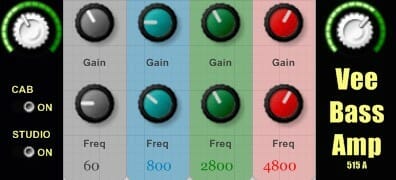
Vee Bass Amp
Key Features
- Tube preamp stage with adjustable gain that drives into smooth saturation at higher settings
- Parallel parametric EQ with independent Low Shelf, High Shelf, Low Mid, and High Mid bands that avoid cross-band interaction
- Hidden 8:1 FET-style compressor in "New York" RMS mode for transparent dynamic leveling without squashing transients
- Switchable bass cabinet emulation with automatic resonance damping and muddiness attenuation
- Studio ambience module that simulates room reflections as if a condenser mic were placed alongside the close mic
- Built-in high-pass and low-pass filters to remove subsonic rumble and high-frequency artifacts before they reach the mix
Description
Vee Bass Amp by Viper ITB is a bass amplifier simulation built around a tube preamp stage, a parallel parametric EQ section, a bass cabinet emulator, and a studio room ambience module. Each of these four stages can be toggled independently, letting you build anything from a raw DI tone to a fully mic'd amp-in-a-room sound.
Under the hood, hidden high-pass and low-pass filters remove subsonic rumble and high-frequency artifacts before they reach the output. A transparent 8:1 FET-style compressor sits between the preamp and EQ, operating in a "New York" RMS configuration that lets transients pass through while leveling overall dynamics.
The EQ section uses a parallel topology rather than the serial design found in most plugins. The signal splits into two identical streams, one routed through the Low Shelf and High Shelf bands and the other through the Low Mid and High Mid bands, before being recombined at the output.
This parallel approach makes EQ adjustments less aggressive and prevents bands from interacting with each other. It is a technique commonly used in analog hardware that allows for more musical-sounding boosts and cuts.
The optional cabinet emulation was specifically voiced to attenuate problem frequencies that bass guitars commonly produce. Automatic resonance damping and level control help tame muddiness, making bass tracks easier to sit in a mix even for producers still developing their mixing skills.
The studio ambience module blends simulated wall reflections into the dry signal, mimicking the character of a bass cabinet recorded with an additional room condenser microphone. Vee Bass Amp is available as a 32-bit VST plugin for Windows.
Video Preview

Frequently Asked Questions
How does the parallel EQ differ from a standard parametric EQ?
In a serial EQ, each band feeds into the next, so boosting one frequency can shift the apparent response of neighboring bands. Vee Bass Amp splits the signal into two identical paths, one for the shelf filters and one for the mid bands, then sums them at the output. This makes large boosts and cuts feel smoother and prevents unwanted interaction between bands.
Can the compressor be disabled or adjusted?
The compressor is fixed at an 8:1 ratio with a threshold at -12 dBFS and operates automatically in the background. It is designed to be transparent enough that you should not hear it working under normal conditions. If you hear pumping, lower the input level rather than trying to bypass the compressor directly.
Does Vee Bass Amp work for recording electric guitar as well as bass?
While it was designed specifically for bass guitar, users have reported usable results on guitar tracks when combined with external cab impulse responses. The cabinet emulation is voiced for bass frequencies, so guitar tones may sound dark without additional high-frequency shaping.
Is the plugin compatible with 64-bit DAWs?
Vee Bass Amp is a 32-bit VST plugin. To use it in a modern 64-bit DAW, you will need a 32-to-64-bit bridge such as jBridge or the built-in bridging that some DAWs provide. Check your DAW's documentation for compatibility with 32-bit plugins.


