
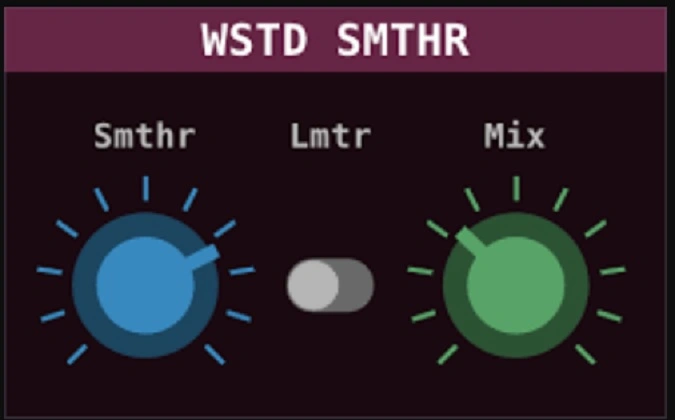
WSTD SMTHR

Key Features
- Soft-clipping overdrive algorithm that adds harmonic warmth and mid-heavy grit to any audio source
- Integrated automated limiter that maintains output within the input signal's RMS level, preventing unexpected clipping
- Minimal control set designed for fast, intuitive operation without menu diving
- Part of the Wasted Audio distortion family alongside CRSHR (bit crusher) and FLDR (wave folder), all derived from the MANGLR engine
- Open-source under GPL-3.0 with no DRM, allowing full code inspection and modification
- Cross-platform support for Windows, macOS, and Linux with VST2, VST3, LV2, and CLAP formats
- Browser-based demo available on the developer's website for instant auditioning
Description
WSTD SMTHR is a soft-clipping overdrive plugin from Wasted Audio that adds warmth, grit, and harmonic character to any signal. It features an automated limiter that keeps the output within the RMS level of the input, so you can push it hard without runaway peaks.
The plugin is part of a family of distortion tools that also includes CRSHR (bit reduction) and FLDR (wave folding), all extracted from the paid MANGLR multi-stage distortion unit. SMTHR focuses on the classic overdrive stage, delivering a snarly, mid-heavy tone that works especially well on acid basses and Reese bass lines.
Controls are deliberately minimal, making it fast to dial in subtle tube-style warmth or aggressive clipping. The integrated limiter sets it apart from most overdrive plugins, which typically require a separate limiter in the chain to prevent overs.
WSTD SMTHR is open-source under the GPL-3.0 license and ships without any DRM. It supports VST2, VST3, LV2, and CLAP formats on Windows, macOS, and Linux, making it one of the more cross-platform overdrive options available.
Output levels can get very hot at extreme settings, so monitoring your gain staging is recommended. A browser-based demo on the Wasted Audio website lets you audition the plugin before downloading.
Video Preview


Tips
- Use the soft-clipping overdrive to add warmth and character to your basslines and synths.
- Experiment with the automated limiter to maintain consistent output levels and prevent clipping.
- Combine WSTD SMTHR with other distortion plugins in series for more complex and textured sounds.
- Adjust the wet/dry mix to blend the overdrive effect subtly or prominently in your mix.
- Utilize the plugin on drum buses to add punch and grit to your percussion elements.
Frequently Asked Questions
How does WSTD SMTHR differ from a standard distortion plugin?
WSTD SMTHR uses a soft-clipping algorithm rather than hard clipping, which produces smoother harmonic saturation instead of harsh digital artifacts. It also includes a built-in automated limiter that keeps the output at the RMS level of your input, so you get consistent levels even when pushing the drive hard.
What is the relationship between WSTD SMTHR and WSTD MANGLR?
SMTHR is one of three distortion stages extracted from the paid MANGLR plugin. MANGLR combines SMTHR (soft-clipping overdrive), CRSHR (bit reduction), and FLDR (wave folding) into a single modular unit where you can reorder the stages. SMTHR is available separately as a standalone plugin at no cost.
Can WSTD SMTHR be used in a Linux DAW environment?
Yes, it is one of the few overdrive plugins with native Linux support. It ships as VST2, VST3, LV2, and CLAP binaries for Linux alongside the Windows and macOS versions, making it compatible with DAWs like Ardour, Bitwig Studio, and REAPER on Linux.
Why does the output get very loud at high drive settings?
The soft-clipping algorithm generates additional harmonics that increase the signal energy. While the automated limiter helps control peaks, extreme settings can still produce very hot output. Monitoring your gain staging and using the limiter as a safety net rather than relying on it completely is recommended.


