Wave Emulation
Key Features
- Recreates the documented Waldorf Wave signal path, from 250 kHz 8-bit/time-multiplexed wavetable voices through filtering, VCA, and panning.
- Models the ES2 ASIC-style signed mixer overflow and 12 dB digital high-pass stage for the instrument's distinctive digital front end.
- Includes CEM3387-inspired three-pole reconstruction and separately saturating nonlinear resonant four-pole low-pass sections.
- Emulates three 16-voice cards for up to 48 voices, with multithreaded card rendering at higher polyphony.
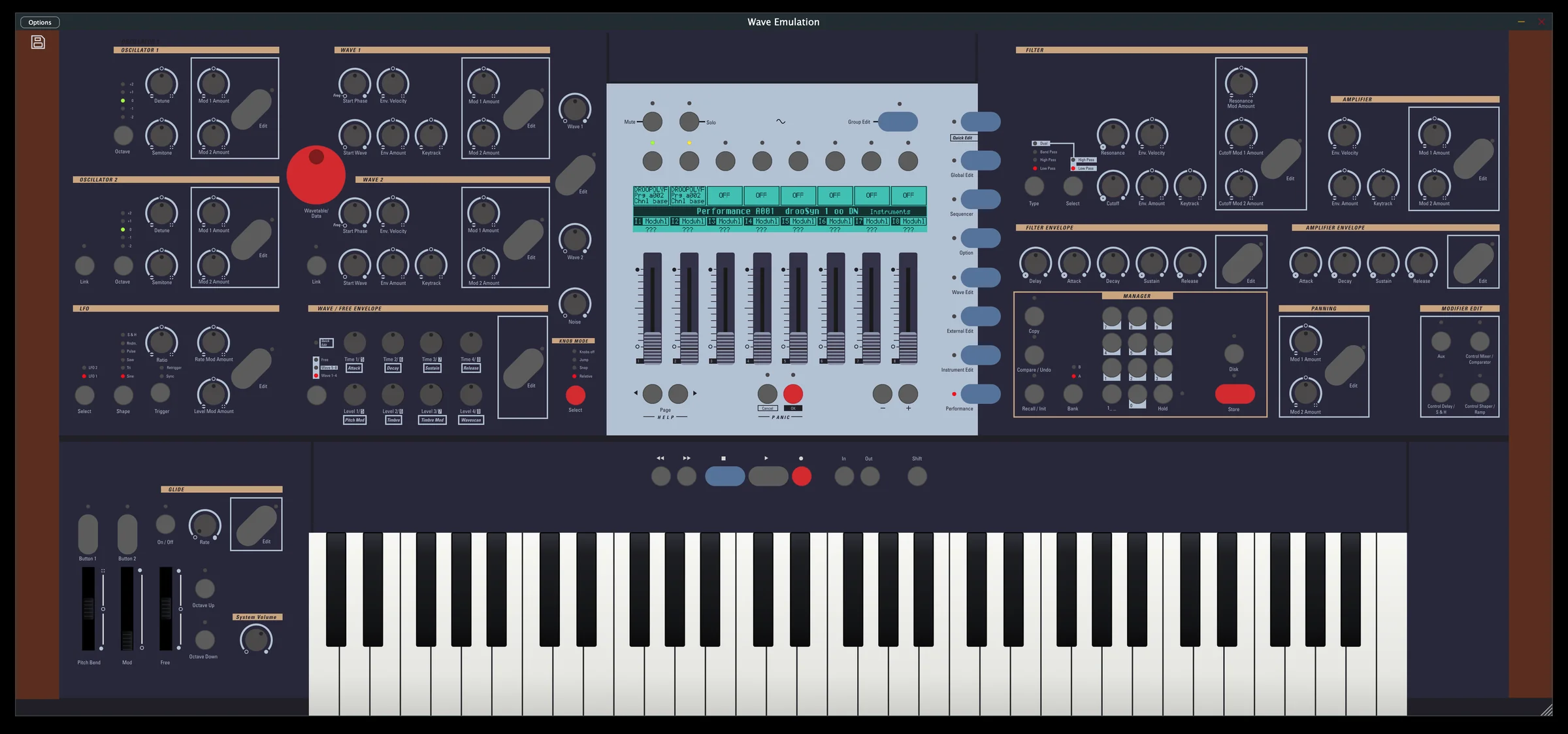
- Provides a 480 x 64 monochrome graphic LCD and an on-screen 61-note keyboard for a hardware-style editing experience.
- Ships as a Windows x64 standalone/VST3 release and a universal macOS standalone/AU/VST3/AAX release.
- Publishes its source under GPL-3.0-or-later, with user-supplied Wave OS files and sound media kept separate from the project.
Description
Wave Emulation is a JUCE-based software recreation of the Waldorf Wave's hybrid wavetable signal path, built by Dave Whiting under the mo0kid name. It models the instrument's 8-bit, time-multiplexed voices, ES2 mixer behaviour, digital high-pass stage, CEM3387-derived filter sections, VCA/panning, and monochrome LCD rather than presenting a modern synth loosely inspired by the hardware.
The current public project includes a Windows x64 build with a standalone application and VST3, plus a universal macOS build with standalone, AU, VST3, and AAX formats. It is a focused instrument for producers chasing vintage digital wavetable colour, hardware-emulation enthusiasts, and developers who want to examine a detailed open-source model.
There is an important setup boundary: the project does not distribute Waldorf's copyrighted Wave OS, voice firmware, factory sound disks, or factory sound sets. You can run the public build with its included decoded PPG V6 wavetable bank and procedural fallback tables, but the original Wave operating system requires your own compatible OS 1.700 files, and authentic sound banks require your own sound media.
That makes Wave Emulation more specialised than a plug-and-play modern wavetable synth. Its appeal is the specific signal path, 48-voice three-card architecture, and transparent research approach; users who only need instant presets or broad cross-platform support will likely prefer a conventional commercial wavetable instrument.
Frequently Asked Questions
Do I need Waldorf Wave firmware to use Wave Emulation?
For the original Wave operating system, yes: the project requires your own compatible Wave OS 1.700 files, including w2sys.bin and wdv.sys. The public build does not include them, although it can open with its behavioural synthesis fallback and included decoded PPG V6 wavetable data.
Does Wave Emulation include the Waldorf factory sounds?
No. The developer does not distribute the original firmware, ROM archives, Wave factory sound sets, or upper factory wavetable payload, so authentic Wave banks must come from sound media you are entitled to use.
Which plugin formats and operating systems are available?
The current Windows x64 release includes a standalone EXE and VST3. The macOS release targets macOS 13.0 or later on Apple Silicon and Intel and includes standalone, AU, VST3, and AAX formats.
Is this a finished, bit-perfect emulation?
No. The developer presents it as a research instrument and hardware-model foundation, not a bit-perfect or circuit-accurate claim. Some oscillator-chip behaviour remains a documented calibration area that needs real-hardware measurements.