Wavetable
Key Features
- Two wavetable oscillators with up to 8x unison, spread, formant, and bend controls for complex layered tones
- Multimode filter with 12dB/24dB per octave slopes and individual oscillator input switching for flexible signal routing
- Six LFOs (three mono, three poly) with 17 shapes plus a 32-step drawable modulation sequencer for rhythmic movement
- Five ADSR envelopes with drag-and-drop modulation matrix for quick, visual modulation routing
- Built-in multi-FX processor with gate, chorus, distortion, delay, and reverb for complete sound shaping in one window
- MPE and MTS-ESP microtonal support for expressive performance and alternative tuning systems
- 150 wavetables and 100 factory presets with cross-platform support including native Apple Silicon and Linux
Description
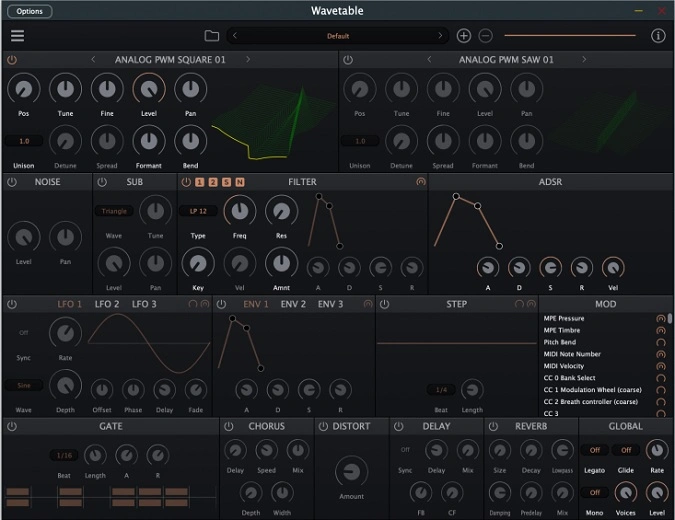
Wavetable by SocaLabs is a wavetable synthesizer plugin built around two wavetable oscillators, a noise generator, and a sub-oscillator. It ships with 150 wavetables and 100 factory presets, giving producers a solid starting point for sound design across electronic genres.
The oscillator section offers position, tune, and fine-tuning controls alongside up to 8x unison with spread, formant, and bend parameters. From there, the signal runs through a multimode filter with 12dB and 24dB per octave slopes in lowpass, highpass, bandpass, and notch modes, with individual input switching for each oscillator.
The modulation engine is where Wavetable punches above its weight class. Six LFOs split across three mono and three polyphonic instances provide 17 different shapes, while five ADSR envelopes (two fixed to filter and amp, three freely routable) handle amplitude and timbral shaping.
A drawable modulation sequencer with up to 32 steps adds rhythmic movement, and the drag-and-drop modulation matrix keeps routing intuitive.
Built-in effects cover gate, chorus, distortion, delay, and reverb, each with a useful set of parameters for polishing sounds without leaving the plugin. MPE (MIDI Polyphonic Expression) support enables expressive performance from compatible controllers, and MTS-ESP microtonal support opens the door to non-standard tuning systems.
Wavetable runs on Windows (VST3), macOS (VST3/AU with native Apple Silicon support), and Linux (VST3/LV2). The source code is available on GitHub, and the developer actively maintains the project with regular updates.
Video Preview


Tips
- Experiment with the different LFO shapes to create unique modulation effects.
- Use the multimode filter to sculpt your sound by switching between lowpass, highpass, bandpass, and notch modes.
- Take advantage of the MPE support to add expressive nuances to your performances.
- Explore the 100 presets to find inspiration and understand the capabilities of the plugin.
- Utilize the multi-FX processor to enhance your sounds with gate, chorus, distortion, delay, and reverb effects.
- Try importing custom wavetables to expand your sound design possibilities.
- Use the modulation matrix to easily map modulators to various parameters using drag-and-drop functionality.
Frequently Asked Questions
Can I import custom wavetables into SocaLabs Wavetable?
The current version does not officially document custom wavetable import. However, the plugin ships with 150 built-in wavetables that cover a wide range of timbres, and the open-source codebase on GitHub means the feature set continues to evolve with community input.
How does Wavetable compare to Vital in terms of features?
Both are wavetable synths with spectral warping and 3D waveform morphing. Vital offers more refined modulation implementation, additional effects, and sample playback. Wavetable counters with more built-in wavetables than Vital's free tier, MTS-ESP microtonal support, and a drawable 32-step modulation sequencer.
Does Wavetable support MPE controllers like ROLI and Linnstrument?
Yes. Wavetable includes full MIDI Polyphonic Expression support, allowing per-note pitch bend, pressure, and slide from MPE-compatible controllers. Users in the community have confirmed it works with Linnstrument, though some report minor DAW-specific quirks with certain hosts.
Is the source code really available?
Yes. The full source code is hosted on GitHub under the FigBug/Wavetable repository. This means advanced users can build from source, and the active development means bugs get addressed and features get added over time.