Xenos
Key Features
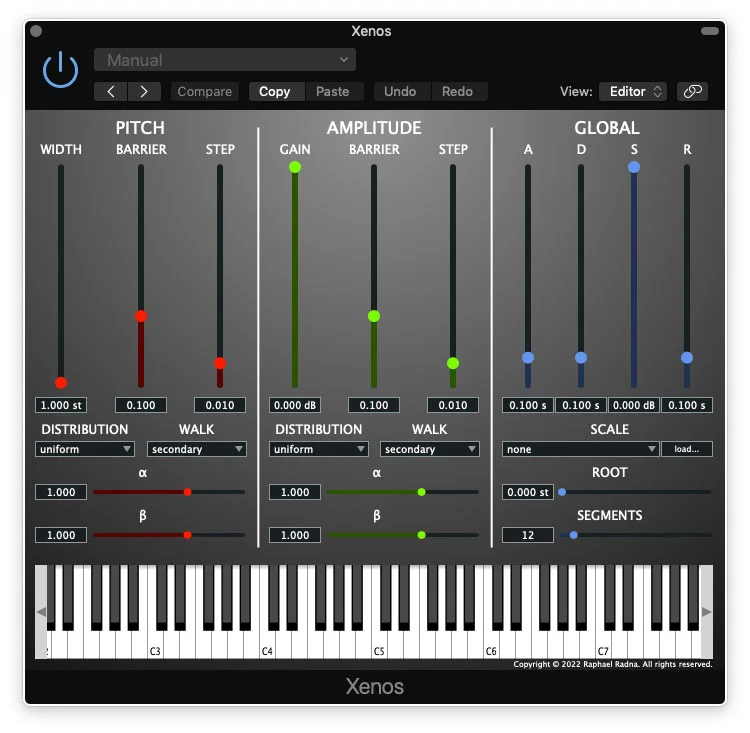
- Authentic Dynamic Stochastic Synthesis engine based on the algorithm by Iannis Xenakis, generating waveforms through probability-driven random variations
- Ten stochastic distributions with up to two adjustable parameters each, offering deep control over the character of tonal randomization
- Xenharmonic pitch quantizer with custom scale import via the Scala format for microtonal and alternative tuning exploration
- First- and second-order random walks controlling wave cycle segment durations and amplitudes for evolving, organic timbres
- 128-voice polyphony with full MIDI implementation including notes, sustain, pitch bend, and external controller assignment
- Variable segments per wave cycle and amplitude envelope controls in the Global section for shaping everything from smooth drones to aggressive noise textures
- Open source (GPL-3.0) and cross-platform, with pre-built binaries for macOS, Windows, and Linux
Description
Xenos is a virtual instrument plugin that implements and extends Dynamic Stochastic Synthesis (DSS), the algorithm invented by Greek-French composer Iannis Xenakis. Built in C++ with the JUCE framework, it brings one of the rarest forms of digital synthesis into a modern plugin format for the first time.
DSS generates waveforms by applying random variations to repeating wave cycles, driven by configurable random walks that control segment durations and amplitudes. The result is an organic, ever-shifting tonal palette that ranges from pitched drones and metallic textures to chaotic noise bursts, all governed by probability distributions rather than traditional oscillators.
The interface is deliberately minimal, divided into Pitch, Amplitude, and Global sections. Ten stochastic distributions with up to two parameters each give you deep control over the character of the randomization, while a xenharmonic pitch quantizer lets you import custom scales in the Scala format for microtonal work.
Xenos is fully polyphonic with 128 voices and supports MIDI notes, sustain, and pitch bend. External MIDI controller assignment and full parameter automation make it viable for both live performance and detailed studio work.
Developed as a master's thesis project at UC Santa Barbara's Media Arts and Technology program, Xenos is open source under the GPL-3.0 license. Version 1.0.1 added Linux support, improved polyphony defaults, and fixed pitch accuracy at non-standard sample rates.
Video Preview

Frequently Asked Questions
What is Dynamic Stochastic Synthesis and how does Xenos use it?
Dynamic Stochastic Synthesis (DSS) is a digital synthesis method invented by composer Iannis Xenakis that generates waveforms by applying random variations to repeating wave cycles. Xenos implements and extends this algorithm, using configurable probability distributions and random walks to control segment durations and amplitudes, producing sounds that range from pitched tones to complex noise textures.
Can Xenos be used for microtonal and xenharmonic music?
Yes. Xenos includes a xenharmonic pitch quantizer that supports custom scale import in the Scala format. This allows you to work with any tuning system, from historical temperaments to custom microtonal scales, making it particularly useful for composers exploring non-Western or experimental tuning.
Is Xenos suitable for musical production or only for noise and experimental sound?
While Xenos excels at experimental textures and generative sound, it can produce pitched drones, metallic timbres, and evolving pads that work in ambient, electroacoustic, and cinematic contexts. The pitch quantizer and MIDI support make it controllable enough for melodic use, though it requires more experimentation than a conventional subtractive or wavetable synth.
Does Xenos support Apple Silicon Macs natively?
Yes. The KVR listing confirms Xenos ships as a Universal 2 Binary, meaning it runs natively on both Intel and Apple Silicon Macs without Rosetta translation.