
Key Features
- Narrow stereo information below a chosen crossover frequency
- Set the crossover with the Below control
- Adjust the bass component with the Width control
- Keep higher-frequency stereo information while narrowing the low end
- Bring off-centre low frequencies towards the middle
- Use a focused two-control interface for quick adjustments
Description
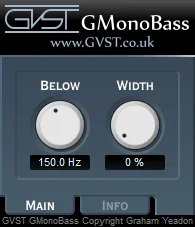
GMonoBass by GVST is a bass stereo imaging effect that narrows low frequencies while preserving the stereo image above a chosen crossover. It is designed for tracks whose low end feels too spread out or off-centre.
The interface has two controls: Below sets the crossover frequency, and Width adjusts the stereo width of the bass component. This makes it quick to choose which part of the spectrum to bring towards the centre without narrowing the whole signal.
On a stereo source, start by choosing the frequency below which the image needs attention, then reduce Width while listening to the result in context. Keeping the higher frequencies wide can retain a sense of space while making the low end more centrally balanced.
The focused design is useful on individual sources or effects returns when low-frequency stereo information is distracting. It does not offer the metering, filtering and extra processing found in larger stereo utility suites, so use your DAW's monitoring tools to judge the result.
GVST offers Windows, macOS and Linux downloads for VST hosts, including a Mac build listed as supporting Apple Silicon. Select the appropriate build on the developer's download page and check your host's compatibility before installation.
Frequently Asked Questions
What does the Below control do?
It sets the crossover frequency below which the Width control narrows the stereo image. Adjust it to target the part of the low end that needs attention.
Does GMonoBass narrow the entire stereo signal?
No. It is designed to narrow the bass component while preserving the stereo image of the higher frequencies.
Can I use it on an effects return?
Yes. A user reports using it on a reverb send to manage low-frequency stereo information; listen in context and adjust the crossover and width to suit the material.


